Whoohoo! I have another update…Burma(also known as Myanamar)rocked…and yes mom and and in am okay, i'm great actually.
So Burma...
On my first day in Burma, I only had time to spend about five hours in the city of Yangon. I would have been more disappointed if it weren’t for the fact that I had five days ahead of me in the country. Tuesday was a freebee day, originally we weren’t supposed to be to Burma until Wednesday.
I got up for the sunrise again, but went back to bed before the sun came up because I wasn’t feeling well. My cough was especially bad the night before, to the point that I was near throwing up. It was awful. I didn’t end up getting to sleep till 4 am which back home wouldn’t be a problem, but here it was. Getting up at 5:45 killed me, luckily I got a couple more hours of sleep in after going back to bed.
By the time I woke up at 8:00 am for breakfast our ship had already begun its trek up the river canal that leads to the port city of Yangon. Fishing boats floated on the muddy river water as MV Explorer passed by. Small golden pagodas spotted the flat, green agricultural landscape.
The diplomatic briefing took a while and by the time it was over with at twelve we had no time to get our things together in order to take the noon shuttle to Yangon. So Anna, Janelle, Sarah and I waited around for the 2:00 shuttle instead. See, in Burma, the port city is, strangely enough, an hour drive from the actual port. For fifteen dollars most of the kids on the ship, including me, bought a shuttle bus pass which picks up from the dock every two hours. The crowd for the 2:00 shuttle was ridiculously huge and even though we arrived outside of the ship at 1:30 we didn’t get on a bus until 3:30.
When we finally got into Yangon at 4:30 we decided to explore, so we set out in a random direction. Right away two children with postcards approached us, trying to sell them to us for three dollars each. The thirteen-year-old girl was adorable and spoke English surprisingly well. Burma is known for having a horrible education system and fewer members of the younger generations know English as it is poorly taught to them, so the fact that the first child I spoke to could speak English so well impressed me.
The girls and I walked around the city for an hour or so, admiring the magnificent golden pagodas placed amidst a dilapidating city. Bald monks draped in red cloth walked among the people, as did the military. Because I have been reading this book about the government of Myanmar and I have learned so many reasons as to why the military regime is horrible, every time I saw a suited officer on the street I found myself scared, intimidated. Indeed, the presence of the military is so evident. It’s not like the streets are covered with nazi-like men, instead they look like police officers scattered throughout the city. Police officers that rarely smile. Oh and speaking of Nazis, I saw hats with swastikas lying amongst a pile of hats for sale on the street. A few days later I found out that the swastika is a backwards symbol for peace (why did I not know that??) and I saw a peace symbol on Tuesday.
But walking around the city was good for us. The Burmese, in their longyis or long skirt-like wraps of fabric, smiled back at us as we passed. Short plastic tables and chairs lye out in from of teashops and dozens of men lined the streets selling watch bands. Countless women and young children had a light cosmetic type of substance spread across their cheeks. It’s made from crushed tree bark and during my stay in Burma I saw so many people wearing it. Some children had their faces completely covered in the yellowish-white chalky substance. Supposedly it offers protection from the sun and also smells good.
An older gentlemen approached us, asking where we were from and how long we were staying. I wanted to carry on a conversation with him but found myself scared to for his sake. The government is everywhere, listening in on people’s conversations, especially when foreigners are around as they don’t want the Burmese saying anything negative about the country.
The four of us walked into a random restaurant for dinner and after looking through the menu full of pictures of chicken hands and other uncomfortably gross meat items we decided to just order drinks. The staff at the diner was extremely friendly, handing us a straw fan to cool ourselves off with since they had no air conditioning. I set my purse on the ground beside my chair and a waiter came with another chair that he placed beside mine, just for me to set me purse on.
We ended up eating dinner at this amazing Thai restaurant, called Sabai Sabai, located near the main pagoda in the city. We had tried to walk there but got lost and resorted to getting a cab because it had gotten dark out and the further we walked, the few street lights we came upon. Our cab driver stood outside of his vehicle as we tried to tell him where we wanted to go. He tried reading the address out of my Lonely Planet book but couldn’t because of the lack of light. So he hopped into his cab and drove around the corner to an area with less traffic. He pulled over the car and got out again. He and Janelle bent over in front of the headlights of the beat-up cab as they studied the text of the book. After some time he understood where we wanted to go and charged the four of us only two dollars total to get there.
So yeah, the food was amazing. I love Thai food so to eat real Thai food, or close to real Thai food since we’re not exactly in Thailand, was amazing. I had the pad thai, one of my favorite dishes back at Thai Spoon, my Chicago love. We each had a large plate of food, shared an appetizer, and had drinks for twelve dollars total. I totally plan to go back before we leave Burma on Sunday night.
On Wednesday I did the City Orientation trip through SAS. Our first stop was the Shwedagon Pagoda, the main tourist attraction in Yangon. After seeing it I understand why. It’s amazingly beautiful. Standing 98 meters tall, it is believed to have been built 2500 years ago.
I don’t even know how to explain it. The huge golden stupa (the center of every pagoda) was surrounded by shrine after shrine. I mean, there were so many areas to worship and pray within the pagoda walls. It was just so massive and elaborately decorated with religious figures that I can’t describe it in a justly manner. Many people sat on their knees around the stupa, praying. I can’t wait to show pictures.
A man came up to Anna and I as we stood around admiring the pagoda and told us how that he teaches English as a profession, asking how we thought his English sounded. It was impressive, he even spoke with only a little accent. He went on about how he had learned American slang over the years by talking to tourists that he met in the city, specifically at the Shwedagon. For the next five minutes he listed the slang he knew such as, “If you made a lot of money fast, then you made a killing!” and “If someone is going crazy, then they’re going bananas!” Soon enough he started listing slang words for homosexuals such as “dike” and “fag.” Anna and I, surprised to hear anyone say those words spoken, quickly informed him that no one uses those terms as they can be found offensive and are not politically correct.
After walking around the pagoda clockwise, as is part of the Buddhist faith, we left the area, reboarded our bus, and headed to the National Museum. Run by the government, it was full of things to look at but few facts. The history covered in the museum didn’t have anything to do with the last 50 years of Burma. Everything was very vague and uninteresting. We next made a stop at this huge (70 meters long) reclining Buddha. It’s gigantic, but supposedly there is an even larger one within the country.
The rest of our tour consisted of roaming the Bogyoke Aun San Market (also known as the Scott Market), which is this huge open building full of crammed together stalls selling fabric, artwork, jewelry, puppets, clothing… just about anything you could want or need. Anna, Cathy (the Chinese woman who is an adult passenger on the ship), and I had long skirts made for us at one stall for a mere five dollars and it only took the woman several minutes to turn the fabric we chose into a wrap-style skirt. Before the city orientation was over we also went to the China Town in the city and walked the streets for a bit.
Oh and during the tour we also roamed the center of the city, which wasn’t a big deal to Anna and I since we had done that the day before. We decided to circle one of the pagodas to kill the allotted time we had. The boy and girl who had tried to sell us postcards the day before found, and recognized us. “You buy now!” the girl said to Anna. It was too funny. The day before, in an effort to get them to leave us alone, we told them that we would think about it and maybe buy some later, assuming we would never see these children again. So when the boy came up to Anna and said, “I remember you,” it was quite a surprise. Anna ended up buying 20 postcards for three dollars, I once again didn’t buy any, but only because I had already bought some the day before.
On Thursday I visited the Mary Chapman School for the Deaf in Yangon. On the way to the school, our Burmese tour guide, Myat, spoke openly about the condition of the country. He talked about how it took him years to get his degree because the universities keep shutting down for large amounts of time and how hard living under the military regime was. I was surprised at how openly he spoke to us, as most people I talked to in Yangon were very reserved when it came to discussing the Myanmar government. As he put it, the country has taken “One step forward, and two steps back.”
When we got to the school we were taken to a room where two different classes were being held. All the children wore white tops and green bottoms. A class of about eight six-year-olds showed us how they knew their ABC’s as they signed the alphabet and attempted to say it as well. Little sound was made, but one girl made many loud indecipherable howls, as she tried to talk each time she signed.
After visiting other classrooms, including a vocational room where deaf students sewed purses and pillowcases to sell, we were taken to the third and top floor of one of the buildings. We sat around for a bit before another group of deaf students entered. We were told that the students wanted to show us their massage skills, apparently they were taught as part of the vocational training so that they can make money off it later in life. Anyway, we thought that we were going to see a short demonstration on one person and Armand, a loud, tall hillbilly who lives on my floor, volunteered his body.
Gradually, more and more blankets were set on the floor and more students were urged to lay down. I held off for a while, confused as to what was going on, until all the SASers on the trip were laying face down on the wooden floor, being massaged by different deaf students. I think it was a faculty member that massaged me since all the students at the school were already busy with others. So yeah, for like the next hour we received free full-body massages. They were different then one’s in the U.S. since they didn’t really massage anything as much as they pushed on certain muscles and bent muscles in different directions.
The whole massage-thing was very confusing. Our trip was supposed to be a “service visit” and here we were being served by these deaf students. And I mean, they had insisted that they show us their skills, but it was strange to me, and the rest of the SAsers, that a full hour of our time had been spent making the children work. We only had about a half an hour left at the school by the time everyone was finished with their massages and none of that time was used to interact with students. Instead we were shown several more rooms in the school.
When the deaf school visit was over Cynthia, this girl whose name I can never remember, and I didn’t reboard the bus and instead took a cab with Armand and another girl to go buy soccer tickets for several games taking place that night. After purchasing the two dollar tickets Cynthia, No-Name, and I went off on our own in a cab and ate lunch at the Green Elephant.
So we shopped for a while after lunch, returning to the huge, compacted Scott Market. I picked up an oriental-type top that I had made for five dollars the day before. It fits well but who knows if I’ll ever where it. After spending money on two dollar t-shirts and dollar watercolor paintings, Cynthia and I parted from No-Name and headed to the outskirts of Yangon where an international soccer tournament is being held until November 2. We arrived at 4:00 pm just as the China vs. Bangladesh game was beginning. Walking into the seating area, heads turned towards the two of us. Not only are we American, but also girls, and very few other females were attending the games. An Indian man ended up sitting in front of me, sexually harassing and staring at me for most of the game. It was pretty upsetting, he finally left when I called a passing SAS boy over to sit by me. The hour-and-a-half game ended in Bangladesh’s victory.
After the 4 pm game Cynthia and I watched the opening ceremonies for the Myanmar vs. India game that followed and then found a cab back to the shuttle. We had wanted to see the second game, but the ship only had the water on from 6-9 pm that night. It was crucial that we took the 7 pm shuttle home so we could make it onboard by 8 and have time to wash away the dirt and sweat from the hot day.
Kathryn left that morning for a two-night stay in Mandalay and having my own room that night was awesome. I stayed up and worked on homework, something I rarely get to do since by midnight the lights in our room our out.
On my fourth day in Burma I visited a monastery where I got to see, and take part in, a Buddhist Novication Ceremony. When we arrived at the monastery at 2:00 pm, the monks, soon-to-be monks, and their families were waiting for us. I guess that, through the money we paid to go on the day trip, we had sponsored the ceremony, so we were very welcomed by everyone. The Novication ceremony inducts young boys into monk-hood and the Buddhist monastery, where they must remain for at least three days after the ceremony, learning the ten Buddhist precepts and begging for food in nearby villages.
Female monks draped in pink and orange cloth stood in an orderly line. Behind them were ten young boys, each sitting on a colorfully decorated wooden flat that was held up by four men. The boys wore white collared shirts, green longyis, and were adorned in pink, green, and gold glitterering hats and vest-type covers. These scared-looking children were the boys who would become monks in an hour’s time. Two men enthusiastically danced inside an elephant costume, flailing the paper machete head left and right to the beat of the drums and woodwinds. Tons of male monks, many as young as eight-years-old, stood around in their red robes, observing the ceremony and the out-of-place American students.
A procession soon began as the line of nuns, the elephant, the monks-to-be, and all the Semester at Sea kids who were carrying offerings of blankets, fans, and other gifts for the new monks, walked up the village street. The parade lasted about ten minutes as we turned around halfway down the street and marched around the monastery. The men who were carrying the seated boys, lifted and lowered the wooden planks the boys were sitting on over and over in celebration. One child was four, at the oldest, and began crying as his sequenced hat, that was far too big for his head, began falling off at the same time.
After the procession the boys were taken into a large room covered in a dark red rug. At the front end of the room a golden Buddha as well as other Buddhist shrines, stood behind a glass wall. In front of the wall sat an adult monk in black plastic glasses who ended up leading the ceremony. Beside him sat several other adult monks. The young boys knelt on the carpet in front of the monks and the ceremony began. It basically consisted of them repeating chants and then removing their clothing, so that they only wore shorts, and having their heads shaved in front of their parents, the monks, and us SASers. The head shaving was interesting as the parents held a piece of cloth underneath their sons’ heads in order to catch their black hair which would later be placed under the same type of tree where Buddha was enlightened. After having their heads shaved, the boys were dressed in deep red cloth, like the rest of the young monks who were all watching the ceremony from the windows and doors of the building.
When the ceremony ended everyone went back outside, searching through the dozens of pairs of shoes left at the doorway. The “elephant” continued its dancing as everyone gathered around it. We were asked to “American dance” around the elephant so we marched in a circle clapping; we didn’t represent too well. After that the young monks crowded around a long rope and played tug-of-war. We SASers were eventually asked to participate and we went up against some of the teenage monks. We won. After three rounds of us winning they made us compete again, this time with no guys. I thought for sure we would still win since we only had three or four guys that had been participating earlier anyway. The monks totally won, pulling with so much strength that two girls crashed to the ground as we were pulled to their side.
The SAS boys on the trip gathered in the center of the circle after tug-of-war and played a game of Chinlon, which reminded me of hacky-sack, only with a much larger object. Chinlon is a traditional sport of Burma and is played quite a bit among the population.
I lost interest in the Chinlon game and began a conversation with one of the teenage monks who was standing around. His English didn’t appear to be one of his strengths so I stuck to simple questions and answers like, “How are you?” He turned out to speak decently well and before I knew it I was being questioned by several monks who crowded around me. “How do you like Myanmar? How long are you here? How do you like the weather? What have you done so far? What do you think of the nuns?” and my favorite, “What is your religion?” I told them I was Christian, which led to the, “What is Christian?” question. Carrie, who had migrated towards me, and I took a deep breath and look at each other, trying to figure out how to explain Christianity to these boys in as brief of words as possible since they had some difficulty understanding us. I said something about praying to one God above. I laughed and felt like a Bible beater as Carrie said to the boys, “Have you ever heard of Jesus Christ?” We never ended up decently explaining our religion as our time to leave approached and we had to exit the monastery and reboard our buses.
Carrie and I, and this boy we had just met, Caleb, didn’t get on the buses that were headed back to the ship and instead took a cab to Sabai Sabai Thai Restaurant, my favorite place to eat. Ever since eating an awesome four dollar meal on Monday I had wanted to go back and Carrie felt the same way so we excitedly returned.
We made it to the Trader Hotel with time to spare and caught the 7:00 shuttle back to the ship. Just in time to take showers and what not before the water was, once again, turned off at nine.
I didn’t have anything planned for Saturday so Carrie and I decided to venture into the city, and using the Lonely Planet I own, figure it out as we went along. So we took the 8:00 am shuttle in Yangon and from there took a cab to a tea shop. Tea shops are all over Yangon and I presume they are all over Burma as well. In Finding George Orwell in Burma the author is in a tea shop nearly every day, observing the Burmese. So yeah, it was important to me that I visit one at some point while in the country.
Carrie and I took a cab to one called Morning Star. Dozens of tables with plastic chairs were placed in orderly lines underneath a large awning. We were motioned towards a table by a young man as we approached. As we had nearly every where we went, we stood out. There were no English menus and none of the many waiters who gathered around our table new English very well so we simply asked for tea. We had hoped to try some food too but because we had no easy way to communicate it was difficult to ask what they recommended. So instead we stared at other tables, observing what was served, and pointed to a fried bread dish that a nearby family had ordered. It was fried goodness. As we drank our tea several bus boys who were about 12-years-old stood within five feet of our table, watching us. It was amusing, the waiters just kept standing near us, despite the fact that the tea shop was quite large. When we would ask our waiter a question other waiters would crowd in to assist in understanding me. A litter of stray kittens scurried around the cement ground, playfully jumping at garbage and other moving objects. I called one over and it begged me for food, unfortunately we had already finished our bread.
After the tea shop we took a dollar taxi to the house where Bogyoke Aung San lived prior to his assassination. Aung San was the leader of Burma’s independence from the British in 1948. In 1947, while leading the Burmese towards breaking away from Britain he was assassinated. In Burma he is looked at as a hero. His daughter, Aung San Suu Kyi ran in the 1990 elections, representing the National League for Democracy. The standing government thought it had eliminated all forms of opposition and allowed the 1990 elections because they thought they would win. But they didn’t. Aung San Suu Kyi won the election by a landslide. In reaction, the military regime refused to recognize her victory and instead put her on house arrest. She has spent most of the last 15 years on house arrest with soldiers guarding her home and has been released for short periods of time only to be exiled once again.
Okay, sorry, but it’s important that you know the story. It’s a huge part of Burma. The government doesn’t let any of the newspapers write anything about her and she is rarely referred to in public because her name is basically another word for democracy, a topic shunned by the government.
So we went to the museum in his home, knowing that it would be censored and contain skewed information. When we entered we had to sign in, telling our nationality and profession, for government purposes I’m guessing. At the most, ten other people had visited the museum in the last week, and they were all Europeans. The empty museum contained pictures of Aung San and his family and some antique furniture, but little else. Aung San was honored in the museum, but more for his work towards gaining independence from Britain and not for his work towards democracy in the country. In fact, nothing was mentioned about democracy. It really was a horrible museum, they were several sentences written next to each artifact, and excerpts from some speeches he gave in the past, but that was about it. I hadn’t expected much though and went more to view the distorted interpretation of the past than anything.
I asked one of the women who was sitting at the doorway of the house, collecting money from the one to two tourists who come daily, what happened to Aung San’s other two children. She wasn’t sure and I was having trouble understanding her so she called over this elderly man who appeared out of nowhere. He walked slowly with a cane and his tan skin was covered in deep wrinkles. His voice sounded like that of a 50-year smoker. He tried his best to answer our questions. Carrie asked when Suu Kyi was born and after much thinking he answered, “1952.” Her father died in 1947 so I knew he was wrong and called him on it. Upon realizing his mistake, the old man laughed hysterically, placing his hand on my shoulder to regain balance. I don’t think we ever got a definite answer but it wasn’t that big of a deal.
Aung San’s house is located a short walk from a busy road, so after visiting the museum the two of us walked through the heat down the gravel road that was surrounded by trees and simple Burmese hut-like homes. Several locals passed us, carrying produce items they hoped to sell to the people living in the area. Our taxi driver from before was parked at the end of the road, waiting for us although we hadn’t asked him to.
We next went to a Yangon hotel that has a restaurant on the 30th floor, hoping to get a good view of the city. After checking out the lookout point we went down to the tenth floor where the spa was located. Word was that it was super cheap. For $2.25 each the two of us got a manicure. It was awesome. I have nails now so it was a first for me. Several other SAS girls were in the spa as well, receiving cheap massages and hair cuts.
Carrie and I headed to lunch at a restaurant that serves traditional Myanmar food before heading back to the Trader’s Hotel, where Carrie hopped on the 3:00 shuttle back to the ship. I didn’t want to go back yet and was alone so roaming the city wasn’t really an option either. Instead, I went back to the cheap spa and got a pedicure for a little over three dollars. Crazy how inexpensive it is, huh? After the pedicure, I had an hour to kill before the next shuttle left so I walked in the direction of Scott Market, down the busy sidewalks full of book stands and fried Burmese food. I walked around the market for a bit before heading back towards the shuttle pick-up. An Indian boy approached me and started a conversation. As I was purchasing a poster from a vendor he asked for some money to eat so I gave him the 500 kyat in change that I had just received. He continued following me, but now he was singing my praise loudly, letting everyone know his appreciation. 500 kyat is the equivalent of 50 cents, I don’t feel like I really did that good of a deed.
On the shuttle ride home, I read The New Light of Myanmar newspaper that I had just picked up from a sidewalk vendor. According to Finding George Orwell in Burma: The Myanmar Press Registration and Scrutiny Deparment (PRSD) has eleven broad rules outlining what subjects cannot be written about. Among other things, they forbid:
Anything ‘detrimental to the ideology of the state’
Anything which might be ‘harmful to security, the rule of law, peace and public order’
Any ‘incorrect ideas’ and ‘opinions which do not accord with the times’
Any descriptions which, though factually correct, are ‘unsuitable because of the time of the circumstance of their writing’
I was really excited to read the thin paper which resembles Galena High School’s yearbook The Spyglass. The headlines consisted of pro-government stories and stories about the Myanmar badminton athletes as well as some international news. On the top of the second page a side-box was headlined “People’s Desire.” Underneath it read:
Oppose those relying on external elements, acting as stooges, holding negative views
Oppose those trying to jeopardize the stability of the State and progress of the nation
Oppose foreign nations interfering in internal affairs of the State
Crush all internal and external destructive elements as the common enemy
And that sums up the Myanmar government. Reading the paper and having a material example of how oppressive the government is made my day.
My last day in Burma was spent doing an SAS trip in a local village. Our buses dropped us off about thirty minutes away from the ship where we immediately paired up and hopped into pony carts. There were a line of them, patiently waiting for our arrival. Jill, a girl I had just met, and I bounced in the wooden covered cart as the large rickety wheels of the vehicle met potholes and other obstacle in the road. During the ride Jill was telling me that her tour guide said that we are often referred to as the “Hello people” obviously because we’re always saying ‘hello’.
The carts dropped us off near a local market where we were given thirty minutes to roam. The village market was much different than the huge Scott market located in downtown Yangon. I don’t really know how to describe it as it was hectic beyond belief and filled with such a variety of produce, much of which was covered in flies. There were stalls selling fresh flowers, men walking around with dead chickens (don’t worry mom, I didn’t get the avian flu), and countless Chinlon balls hanging from the tops of stands. As we walked through the crowd of locals I was hit with a horrible stench of what smelled like throw-up. I tried my best not to make a disgusted face as the strong odor that came and left, crept up into my nostrils.
I’m glad I got to see a local market, but by the time we reboarded the buses I was ready for our next destination. Beads of sweat had been dripping down my back the entire time we explored and by reboarding the air conditioned bus I was given time to dry off.
We were driven for a few minutes around the village before unloading once again. Dozens of trishaw drivers stood along side their bikes. Each SASer sat down in a small wooden seat that was connected to the bicycle. For the next five to ten minutes we rode around, being pulled by these trishaw drivers, many of whom were significantly smaller than the average American person. We reached a slight incline and each driver jumped off their bike, pushing us uphill. For most of the ride we sped down a bumpy road, and yes, I was scared. The trishaw didn’t look like the safest mode of transportation available and as the wooden seat vibrated from the scattered gravel on the road, I couldn’t help but wonder what would happen if a wheel broke off. Needless to say, I was very relieved when the ride was over.
The drivers dropped us off in a village neighborhood. We walked around for a bit, waving at children who ran out of their homes to stare at us and then had to reboard the trishaws and travel back to our buses. The rest of the trip consisted of us visiting a tea shop and a Catholic church. The tea shop served us Chai tea that tasted much different than what we were used to in the states. Several pastries were placed on our table, including a roll filled with red beans. I eventually forced myself to try it. A television screen played music videos of an Asian “J-Lo” singing her rendition of “Summertime Blues” in a foreign language, presumably Burmese. Everyone was noticeably dying from the heat and, in turn, we were handed straw fans to use while we waited for our call to reboard the bus.
I was back on the ship by 1:00 in the afternoon and at 2:00 I boarded the shuttle for Yangon. Once in the city I met up with my group of girlfriends and we rode taxis to Sabai Sabai. It was important to us that we eat there one more time before leaving Burma. Unfortunately, it was closed. So we settled for a different thai restaurant in the city and after eating, went back to the Trader’s Hotel where we took the packed 5:00 shuttle back to the MV Explorer.
Although everyone had to be back on board by 9:00 pm, our ship didn’t leave until the next afternoon as we needed to exit through the river canal, or whatever it was, during high tide.
I loved Burma, or Myanmar. Because the country has not been a stop for previous Semester at Sea voyages, and because the United States has enforced sanctions, few Americans visit the country. Everything felt very untouched. Of course, I spent most of my time in a busy city that many people say does not represent Burma properly. But all the same, I interacted with locals and noticed the underlying government presence everywhere. From the drink called “Pop-Soda” to the no honking signs throughout Yangon, I tried to take it all in because who knows when or if I will be back.
Next up is Vietnam on the 5th.
Oh and Halloween on the ship was definitely different. I wasn’t going to dress up. I didn’t want to dress up. But then Kathryn and Anna were in my room in their “Burmese twins” outfit, encouraging me to be a fried egg. So I slipped on a yellow and white skirt I have, put on a white top and tape an orange circle to my chest. Erin didn’t have a costume either so we ran up to her room, made her put on brown clothes and taped fat-type wavy strips to her and a post-it that said “Sizzlin’.” So yeah, we were bacon and eggs, clever, I know. But it worked.
There was a community college, which is what we call the educational night programs on the ship, about pumpkin and food carving. Kathyrn, Anna, Janelle, Erin, and I had two pumpkins between the two of us and spent the next 45 minutes trying to create an interesting-looking pumpkin. It was a good time and since there are no trick-or-treaters or fall leaves around, the smell of the pumpkin made it actually seem like Halloween for me. There was a costume competition later that night too and everyone paraded around in their unique costumes.
So yeah, everything is going great here. People have stopped emailing me! But I’m doing well so it’s all good. But I do miss updates. Hope all is well. Much love.

Wednesday, November 02, 2005

Monday, October 24, 2005
India!!
When I typed my journal it was 11-pages long and, not wanting to cut out much, my blog is nine pages long. I’m sorry. I don’t expect anyone to read it except for mom, dad, and especially Deb since she is my baggage carrier. Grandma, you better read this goodness too.
I loved India though and if you read nothing else just know that.
As the alarm does every morning that we reach a country, it went off extremely early in India. Being awaken from a deep sleep I found myself angry and confused about why I was getting up. Arriving in India seemed unreal to me and in turn, I didn’t think very much about it before that morning. So when Kathryn and I rose to see the sun come over the horizon I wasn’t in the right mindset. As I climbed the five flights of stairs in order to reach deck 7, I found it finally hitting me. My new song became “We’re in India!” sung to the tune of my Alaska song “It’s my last day!” Only Allison would understand.
The sunrise was somewhat disappointing. Clouds covered the sky and a faint hole in the darkness let some of the orange sunlight shine through. Carrie, Kathryn, and Erin soon deserted the sunrise ritual in order to go use the free internet before everyone else got up and it slowed down drastically. I stayed outside for another 20 minutes, trying to grasp the fact that our ship would soon be in India. In the far off distance coastline was visible. The Christian kids on board stood around with guitars, singing Jesus songs in harmony.
I eventually gave into to the temptation of free Internet, left the hot, muggy outdoor air, and retreated to my room to grab my laptop. For the first time since our Internet began being free two days earlier, it was fast enough for me to send out emails. By the time I met the girls for breakfast at 7:30 the ship was along side the huge cement parking lot of a dock. Outside dozens of dark figures stood around, some waiting to inspect our paperwork and others wishing to offer us rides throughout the city on their auto rickshaws. A stray dog, one of the many we had been warned about, lay calmly among the men.
Clearing customs took quite some. On top of that, everyone had to collect their passports and paperwork from the ship. There were numerous announcements over the loudspeaker as administration got upset that not everyone had picked up their passports. Finally, at 11:45 am, I officially entered India.
I spent the day with two girls, Cynthia and Ashley. In India you can’t travel with many more people; three is the maximum amount you can squeeze into a rickshaw. As soon as we stepped off the ship we were bombarded with offers to take us anywhere in the city. We held off for a bit, wishing to at least walk away from the ship before we set ourselves on a specific cab driver. At the end of the parking lot area rows of rusty manual rickshaws stood, their drivers approaching SAS kids insistently. There were a few cabs in the area and the man we agreed to go with happened to lead us to one. His price of one dollar each was hard to resist. The three of us squeezed onto the torn-up velvet seats in the tiny cab.
The man who recruited us for the cab ride turned out not to be the driver. Instead, he was the one who talked to us about where we wanted to go. We hadn’t driven five minutes before our cab slowed down and the man jumped out of the front seat and disappeared. I thought little of it as our ride continued slowly down the street. Around the corner some officers looked at our paperwork and ushered us on. A moment later, on the other side of the police barrier that he had merely walked around unnoticed, the man jumped back into the front seat and we continued on our way.
I was mesmorized by the drive. As we rode along busy streets we passed motorcycle after motorcycle. Everyone rode them. Women sat on the back of the bikes with their legs hanging off one side, in a lady-like manner. One bike had a mother, father, and small child all crammed onto it. Crowds stood along the side of the road, waiting for public buses. Several women swept dirt around on the concrete with what we would consider “old-fashioned” broomsticks. On the dashboard of our cab was a small shrine to one of the Hindu gods. A sticker of the praised “lingum” or penis was stuck to the black plastic dashboard also. The open windows of the cab supplied a breeze which helped with, what we considered, oppressive heat. Thick dusty air filled my lungs. My throat is still sore.
Our first stop was a bank as we had asked. The driver parked the cab across the street and the other man lead us through the busy street, putting his hands out as though traffic would stop, or even slow down for him. Crossing streets in India is not easy, wait, scratch that. Crossing streets in India is dangerous.
Anyway, after the bank we told showed him a map and pointed to a specific place we wanted to go to shop. “No, no. I take you somewhere cheap that’s close. That’s very far,” he told us. Ten minutes later we pulled up to a large cement building. “Go inside,” he urged us. The building was not what we had expected as it was not the markets we had wanted to go to. It turned out to be a really expensive fabric/everything else Indian store. We knew we were being overcharged but wanted to be polite so we walked around for a bit. On the second level were two American brothers from Nebraska and surprisingly they were not with Semester at Sea. The older brother who was about our age explained to us that he too had been brought to the store by his cab driver. The drivers receive commission if they drop a tourist off at certain stores.
So we went back outside and told the man, who was still waiting with the cab, once again where we wanted to go. To make a long story short, he ended up taking us to three more overpriced stores and kept telling us “Yes, after this store I’ll take you there.” So finally I was firm with him, insisting that “Spencer Plaza is where we want to go, no where else.” “Okay, two more shops first,” he said, which was funny to us because at the last shop I had made him promise me that this was the final one he was dragging us too. We argued for awhile and I continued insisting that we only wanted to go to Spencer Plaza, even though he claimed it was an hour drive. Finally the cab driver mumbled to us, “Okay, Spencer Plaza.” It only took us fifteen minutes to get there.
By the time we reached Spencer Plaza we were starving and anxious to eat so we grabbed some food from an Indian bakery/fast-food restaurant. It was my first real India food experience. The vegetarian samosa and wrap-type-of-a-thing that I got were spicy as heck. After downing pepto-bismo, I ate the samosa quickly, trying to ignore the burning in my mouth. When I finally took a deep breath I realized how hot my face, as well as my mouth, felt and as I sniffed due to my now running nose, I downed water out of my Nalgene. The small wrap I had gotten was even spicier than the samosa. I was able to get two bites down before passing it on to Ashley to finish.
Ashley, Cynthia, and I spent the next four hours walking around the three-story mall. Many of the stores sold the same things: purses, jewelry, wall-hangings, etc. Cynthia and I had tops made for us at a fabric store and by the time we left the mall at 5:30 they were completed.
Our ride back to the ship that night was much smoother. We hopped in one of the bright yellow auto-rickshaws outside of the mall, squeezing ourselves and our purchases inside the doorless vehicle. The ride was terrifying, but by the time I left India I had gotten used to passing other vehicles while busses hurdled towards us. I sat wide-eyed, the entire way back, sure that I was going to die.
I had planned to go out to dinner with Anna that evening, but was exhausted and she suggested we just eat on the ship. So we did, afterwards she sat in my room while I showed her each purchase I had made earlier in the day. We call it “show-and-tell” and it has become a tradition after each port now.
After show-and-tell I showered, packed, and attempted to journal before meeting with the thirty other kids who were going on the homestay visit with me in Erode, a south-central village. We met in the Union at 10:00 pm and by 11:15 were walking through the Chennai train station. On the way to the train station I saw families lying on the sidewalk to sleep. Homelessness was everywhere. People slept on the brown cement that covered the crowded train station. A thin shirtless old man laid out several dirty blankets before resting on them for the night as the thirty of us stood ten feet away, waiting for our train. When we entered the station rows upon rows of hundreds of Indians sat in the main area, waiting for their trains. It being my first day in India, I wanted to take a picture so badly. But I couldn’t. Everyone was staring at us, heads completely turned to the side, just as we were staring at them. So many times in India, and in all the ports, I’ve wanted to take certain pictures but haven’t for both ethical reasons and for the sake of not being too obtrusive.
A little boy who was missing half of one of his arms followed us around in the station. He motioned to me that he wanted his picture taken and so I took one, showing him his picture on the back of my camera. Another trend in the countries we’ve visited is that people, usually children, want their picture taken for the sake of seeing themselves on the back of our cameras. One girl on the homestay visit with me calls it the “township game”. When we were in the African townships, many of us were bombarded with kids pushing each other out of the way as they stood in front of our cameras. In India this was the case as well. At the Dalit village we visited, young children noticed the camera in my hand and requested that I take their picture. Soon I was surrounded. The older kids often beat out the younger ones in the battle to be in front of the camera lens. Several times, older siblings got my attention and motioned that I should photograph their little sisters or brothers who were quietly standing in back of the group.
After walking through the rice paddies in the Dalit village, an old man who spoke no English attempted to communicate with me. I shook his hand and after a while realized that he wanted his picture taken. As I got my camera out and turned it on he dropped his cane at his side and stood tall in preparation. He must not have realized that I was able to show him the picture right then and when I turned my camera around so he could see himself he lit up. His eyes widened and he exclaimed in joy, putting his hands together in a prayer pose, thanking me.
So anyway, back to the train station. We stood around sweating for about a half an hour before we boarded the train. We were in first class sleeper cars, which was a relief as the other class consisted of tightly packed, poorly-ventilated cars with bars over the windows. It’s not like first-class was that much better though. I didn’t mind it. “We’re in India!” was basically my answer for everything and I found it easy to deal with the less-then-perfect accommodations. Aparna, a rich girl from Houston who I paraglided with in Venezuela, made me laugh as she sat on the blue plastic-covered seats with a worried, disgusted look on her face. I slept decently well in the train that night, only covering my legs with the blanket they provided because I doubted its cleanliness. I wore my fleece and woke up in the middle of the night to find myself covered in sweat, a constant theme during my 5-day stay in India.
We arrived in Erode at 7:00 am the next morning. From there they split us into two groups and sent us to separate host families. Driving through the “town” of 250,000 people was interesting. Pairs of oxen with painted horns pulled wooden carts down the road. Brightly colored plastic containers of water were carried on top of heads. And of course, all the women were wearing sarees, as they were in the city as well.
We arrived at our homestay house, were showed our rooms for the night, and were served breakfast right away. It was awesome. Every meal the family served us was amazing, in fact. Varieties of rice and bread dishes with different sauces made up all our meals. They weren’t too incredibly spicy, many of the meals on the SAS trips weren’t, because our hosts had been told to bland it down a bit since most of us were not used to such hot food.
Oh and the host family we stayed with, they were such good people. There were eight members of the family at the farm. The property is owned by the older members of the group, the grandparents, but their three children, as well as one of their sons’ wife and two children were there. The children, ages 12 and four, were adorable although I didn’t talk to them too much.
After breakfast we received a tour of the families’ property. We walked down a narrow road surrounded by palm and coconut trees and stopped to watch a man who worked for them scale a coconut tree. It was impressive. He used this manual contraption to balance out his body weight and climb the forty-foot tall tree in seconds. At the top he picked coconuts and threw them to the ground. After climbing back down, he got out a small machete and sliced open the tops of the coconuts and a teenage boy placed straws in the holes, handing them to each of us. Some of the boys on our trip attempted to climb the coconut tree as well in the same fashion as the man had, and failed miserably.
We loaded back into our mini-buses after a bit and were taken to a sugar refinery. Sugarcane was crushed by this machine the squeezed out the liquid that then flowed into this huge wide-rimmed bowl that looked like a gigantic soup bowl. From there it’s stirred around and sifted through and at some point during the process it becomes sugar, really I don’t remember. The hut where the steaming bowls were was unbearably hot. Three women were inside pounding the already processed sugar into a packed circular form. Their tiny girls stood around looking up at us.
Next we traveled further down the road to see thread made out of coconuts. Tall stacks of split and dried coconuts laid everywhere. The thread from these dried coconuts is processed and made into rope. The work was done outside but a dark cement building sat beside the processing machine. There were several children inside, two of which were terrified of us. One two-year-old boy stood behind his grinning brother with tears in his eyes as he stared at me.
After that we were dropped off at a village and allowed to roam. Few people in the village spoke English so a member of the host family accompanied me as I tried to make conversation with some of the locals. I was invited into one older woman’s home. There were five rooms inside all of which were painted either bright green or turquoise blue. I looked around the house and the woman, excited to have me in her home, came out of her kitchen with a plate of small bananas. (By the way, all bananas in India are like half the size of the ones in the U.S.). I declined the offer because I was not hungry and I just feel bad taking from people who have less than me.
Before leaving the village we briefly visited the school down the street. The uniformed children were so excited to see us. One ten-year-old girl put her hands up as though to play “patty-cake” or whatever it’s called. We clapped our hands together and she tried teaching me a routine but I didn’t do too well. She also taught me a handshake that began with us touching thumbs and eventually shaking hands. I tried it about ten times before I got it down. I was forced to leave before long since our bus drivers were rushing us. I felt like a movie-star as I was leaving. Everyone wanted their hands shaken. The kids were pushing their hands towards me with big grins, one after the other. I shook as many hands as I could before I had to run off. The kids stood on the porch of their one-room school, waving frantically at me as I ran to the buses.
Back at the farm house we ate lunch off of bamboo leaves that were lined up along the floor. I ate with my hands, as is the custom in India. Scooping rice with my fingers was definitely something new for me. I sat next to Purni, the mother of the two children at the home. She was a really interesting woman to talk to, very well-spoken, and I learned a lot from her.
For quite some time after lunch we all sat around, drinking coffee and tea, and talking with the host family about everything from politics to marriage. Purni got out old photo albums for us to browse through. I retired to my room for a half-hour nap at one point because I was losing all my energy from the already-very active day.
October falls right in the middle of monsoon season in India and it started raining somewhat heavy in the late-afternoon. It died down after a while and we were taken to the village markets to walk around. We weren’t there five minutes before it started pouring. The local vendors let us hide-out underneath their tarps while huge puddles formed and water dumped from the sides of the tarp. The rain didn’t let up and eventually we were forced to run through it and towards our buses, splashing in the unavoidable puddles on the way.
We spent the rest of our evening at the farm house. Purni and I talked for quite some time about marriage and her children. After dinner a drum band performed for us on their property. We didn’t want to dance but were asked to and so many of us danced around in circles with the drummers, making fools out of ourselves. Another reoccurring theme in India is locals wanting us to dance or perform for us. I can think of five times off the top of my head that we had to dance or sing.
Before going to bed I cleaned my feet in the sink since I was confused by the provided shower system of a faucet and bucket.
I slept horribly on the hard beds that night, partly because I was stuffed up. Oh yeah, have I mentioned that I’m sick again?? A week and a half ago I finally got over my cold only to recatch it the day I entered India. I’m frustrated, I just keep getting sick.
So we got up at 6:00 am, had coffee, and left our host families house for good. The twelve-year old girl cried as we were leaving. We were taken to a school for children up to standard 12, or age 16. Some of the older children stay at the school in dorm-like setting. They supplied us with breakfast and hurried us back onto the buses.
We went to two different temples, the second of which was amazing. It was a whole complex of temples, with an elephant that blessed us with his trunk, and a river alongside with people washing clothes and carrying on their daily routines. Our group walked around barefooted, being stared at by locals. I saw a monkey walking around on top of the huge entrance shrine, I got a kick out of it.
Next we went to a carpet weaving center. Tons of looms were in the back of the center underneath two parallel huts. Women were spinning thread and making large rugs in the heat. Before leaving we practically bought the store out because everything was so cheap.
Our next stop was a disabled children’s school. Most of the kids, perhaps all of them, have polio. We were taken upstairs to a room where about seventy kids sat in tightly packed rows on the ground, waiting for us. The school put on a show for us with different groups of students dancing or doing karate. Many of the kids performing had fake legs, or feet that were turned inward as the walked on the sides of them. You could hear their leg braces creaking as they danced. After their show one of the heads of the school asked us to perform for them. We stood up and did the hokey-pokey and then sang “Take Me Out to the Ballgame.”
We returned to the school we had eaten breakfast for lunch. Afterwards our group was given time to roam around to see the school. I began talking with a sixteen-year-old girl and soon she was introducing me to her friends, pulling them out of crowds of students who were watching me as I passed by. Before I knew it I was surrounded by teenage girls, asking me questions and making small talk with me. They ended up guiding me around the school, showing me classrooms, where they sleep each night, etc.
I wasn’t a huge fan of the way they would encourage me to go into classrooms where classes were in session. “Do you want to see?” they would say and so I would walk in, disturb the class, and feel very awkward as everyone stared at me. One time the teacher stopped class and asked me to speak to the students. So I stood there, all gross and sweaty, and told them how welcomed everyone was making me feel and that I appreciated their letting us see their school, etc. Then it got quiet and nobody said anything, they just stared at me waiting for me to say more. Another time I went into a classroom and the teacher told the students to ask me questions. One boy raised his hand and asked, “What is your name?” “My name is Annie,” I said, having not spoken yet to the class. The entire class burst into laughter as though I had just told a joke. I smiled, not understanding what was so funny. Another boy walked up to me, bowed, and said, “Welcome.” All his classmates laughed. I swear, I was laughed at so many times in India, as were all the other SASers. Kids got such a kick out of hearing us talk or seeing us dance.
We walked around the school yard and young children continually ran up to me, pen and paper, in hand, wanting my autograph or email address. I stopped to play basketball with a few of the boys and tried to get a game of lightening started but it was too hectic and getting the kids into a line was impossible.
The girls really wanted me to see where they slept so I climbed the flights of stairs to the third floor of a nearby building and saw the large room that was separated into tiny sections by four feet tall walls of cement. Each section had a bed and a desk that took up the entire space. The adult in charge of the floor of girls greeted me as well, bringing me a plate full of pomegranate seeds and a glass of water. Trying to be polite, I ate quite a bit, encouraging the girls to join in eating the seeds, but instead they left the food for me and stood around watching me eat as sat on one of the beds.
At 4:30 a group of girls dressed in beautiful sarees performed for us on the school’s stage. All the children stood behind the chairs that had been placed out for us SASers to sit on. The girls danced beautifully and when they were done the teacher who had introduced them asked us to come up to the stage to dance with them. I made a fool out of myself as I tried to follow their moves. After dancing we were asked to perform even more for the kids. We did an unorganized version of the electric slide and some of the boys did the worm, which the students loved.
After the performance we were herded off once again, this time to visit a medicine factory. We learned about some herbal remedies and saw actual medicine being made. I randomly saw a peacock on top of a neighboring school building, which shocked me.
So we went back to the school for dinner and as soon as I arrived the girls from before found me. “Do you remember me?” many of them asked. The worst was when they would ask if I knew their name because I never did. “Eh, let’s not play that game,” I said. Dinner wasn’t quite ready so I stood around and talked with the group of girls who had gathered around me. They asked me so many questions, and I did the same to them. My favorite question was “Do you have any friends who are boys?” I told them yes and explained how in the U.S. girls and boys hang out together. In India, it’s rare, in fact girls have little contact with boys until they are married through arranged marriages in their early 20s. “I have had a boyfriend too,” I told them and they giggled in shock. “Have any of you ever kissed a boy?” I asked, knowing the answer. They all gasped, “Oh no, no, not until we’re married,” a girl said quickly.
When dinner was served several of the girls brought their plates to the bench I was sitting on and gathered around me in plastic chairs. They asked me why I was eating with silverware as all of them ate with their hands. The honest answer was that my hands were filthy and I didn’t want them to touch my food.
“Tell me about your culture,” one girl asked and I told her about the 4th of July. She then wanted to know what my daily routine was. All the girls laughed when I told them that back home I usually sleep in till 11 am. “We go to bed late and get up early every day…I’m always tired,” someone told me. The girls asked me if I sang and I told them that I used to in high school but don’t anymore. Soon they were begging me to sing. I refused. One of the girls, who told me to refer to her as “Honey” because I couldn’t remember her beautifully long name, sang to me. When she was finished she looked to me, expecting that I would sing back. Finally I gave in, and after finishing an extremely spicy meal I sang the group of girls, “Wading in the Velvet Sea” by Phish. I didn’t do very well, being sick wasn’t helping me, and I was embarrassed because other SASers could here me, but the girls applauded when I finished and told me I have a “sweet voice”.
As the evening progressed I fell away from the girls and found myself surrounded by young boys who wanted to shake my hand. I asked about their hobbies and a 10-year-old boy told me he like to draw. He ran up to his room and brought down a large envelope full of drawings to show me. They were really good. I was so impressed that I called over some of the boys on the trip with me to see.
At about 9:30 we had to leave the school in order to make our train back to Chennai. Before leaving some of the guys sang their rendition of, “You’re Lost That Lovin Feelin,” for a group of young boys. It was loud and off-key, but very entertaining.
The train ride back to the city was decent. We almost left without a couple students as they had gone off to make phone calls and the trained arrived early. The train had already started moving without them but they managed to jump on as it headed out of the station.
The train got into Chennai at 6 am on Saturday morning. Back at the ship I showered, repack, ran to breakfast, and met a group of students in the Union at 7:45 for yet another SAS trip.
The thirty of us rode buses for about an hour and a half until we reached the Dalit Delta Center, a nursing school for girls our age. Upon arriving we were given strings of flowers to wear and presented with a long show full of a million different performers.
We had lunch at the center and then were given an hour or so to walk around the area. Standing outside of the cafeteria area, I saw a mob of young children in the distance running towards a couple of us yelling “Hi!” Part of me wanted to run back into the building, but I stayed and shook their hands as they came up to me holding them out. A group of girls my age came and “rescued” me and a few others from the children and showed us around the area. We ended up in one of the bedrooms, sitting around and talking.
Around 4:00 we got back into our buses and were driven to a Dalit village. Crowds of people swarmed around our buses, women put strings of flowers over our heads, and men beat loudly on drums as two dancers balanced multi-colored ornaments on their heads.
They paraded us around the village, children walked beside us asking what our names were and offering a handshake. Women walked out of their huts to view the commotion. It felt like the whole village was walking with us down the dirt road. A 16-year-old boy kept asking me to dance and so to humor him I skipped along several times to the beat of the drums.
After the parade we sat down in front of a cement stage three feet tall. The children gathered in front of our seats, sitting on the ground to watch the show that followed. The rest of the village stood around behind and next to the plastic seats we had been given. We were each given a coconut full of milk to drink. For the next two hours we watched a show full of dancing and “magic tricks.” Sticks of fires were hurled around, carrots were placed on young boys and sliced by a blindfolded man. It was entertaining but it lasted far too long. By the time the show ended the sun had set and it was dark out. We were led directly to our buses and taken down the road about a mile to an empty home where we were spending the night.
We didn’t stay in a hut for the night, but rather, a large house with three stories and marble floors. It was still pretty dirty though. Upon arriving at the house we had a meditation ceremony with prayer candles and then ate our boxed dinners that the ship had provided.
The next morning we were up by 6:30 but didn’t get back to the Dalit village until 8:30. In case I forgot to mention, Dalits are referred to as the “untouchables” in India. They fall at the lowest class in the caste system, which is a huge part of Indian society. Until recently, Dalits were discriminated against and not granted many of the basic rights that other Indian citizens had. Dalits are often marked as inferior people and looked down upon.
Anyway, we were only given about an hour to roam the village and in that time we were led down the narrow rows of intersecting dirt that separate the rice paddies field. Men sat in the six inches of water in each paddie, cows pulled plows over the crops. We were invited into several homes, all of which had no beds, only a cement floor and minimal decorating with religious shrines. I wish we had been given more time to explore, but unfortunately we were rushed back onto our buses around 9:30. By noon we were back at the ship and I was taking a long, hot shower.
So India is over with, but I plan to someday return. After all, I have to see the Taj Mahal at some point. From the squatting toilets, to the head bobble of the Indians, to cows running out in front of vehicles, the entire experience was amazing. Everyone back on the ship is telling stories of how they were dragged from store to store by their rickshaw drivers and how guilty they felt at turning down begging children. I just can’t believe I’ve been in India and we’re already moving onto our next port. And speaking of our next port, we’re already there. In a few hours we will dock into Yangon, Myanmar where we will spend the next six days. Mentally I don’t feel prepared for an entirely new culture, especially because we’ve only had time for one global studies lecture on the country and I only had one day on the ship to collect my thoughts after India. I’m sure I’ll have a good time regardless though.
And as of yesterday I am exactly on the other side of the planet from everyone back home. Crazy to think about.
Oh and I am following the World Series. Some boys on the ship get up each morning that there is a game and pay 40 cents a minute to watch the broadcast online. I wish I was in Chicago to feel the excitement. Go Socks!
K. Time for Burma, or Myanmar, or whatever you wish to call it. Much love.
I loved India though and if you read nothing else just know that.
As the alarm does every morning that we reach a country, it went off extremely early in India. Being awaken from a deep sleep I found myself angry and confused about why I was getting up. Arriving in India seemed unreal to me and in turn, I didn’t think very much about it before that morning. So when Kathryn and I rose to see the sun come over the horizon I wasn’t in the right mindset. As I climbed the five flights of stairs in order to reach deck 7, I found it finally hitting me. My new song became “We’re in India!” sung to the tune of my Alaska song “It’s my last day!” Only Allison would understand.
The sunrise was somewhat disappointing. Clouds covered the sky and a faint hole in the darkness let some of the orange sunlight shine through. Carrie, Kathryn, and Erin soon deserted the sunrise ritual in order to go use the free internet before everyone else got up and it slowed down drastically. I stayed outside for another 20 minutes, trying to grasp the fact that our ship would soon be in India. In the far off distance coastline was visible. The Christian kids on board stood around with guitars, singing Jesus songs in harmony.
I eventually gave into to the temptation of free Internet, left the hot, muggy outdoor air, and retreated to my room to grab my laptop. For the first time since our Internet began being free two days earlier, it was fast enough for me to send out emails. By the time I met the girls for breakfast at 7:30 the ship was along side the huge cement parking lot of a dock. Outside dozens of dark figures stood around, some waiting to inspect our paperwork and others wishing to offer us rides throughout the city on their auto rickshaws. A stray dog, one of the many we had been warned about, lay calmly among the men.
Clearing customs took quite some. On top of that, everyone had to collect their passports and paperwork from the ship. There were numerous announcements over the loudspeaker as administration got upset that not everyone had picked up their passports. Finally, at 11:45 am, I officially entered India.
I spent the day with two girls, Cynthia and Ashley. In India you can’t travel with many more people; three is the maximum amount you can squeeze into a rickshaw. As soon as we stepped off the ship we were bombarded with offers to take us anywhere in the city. We held off for a bit, wishing to at least walk away from the ship before we set ourselves on a specific cab driver. At the end of the parking lot area rows of rusty manual rickshaws stood, their drivers approaching SAS kids insistently. There were a few cabs in the area and the man we agreed to go with happened to lead us to one. His price of one dollar each was hard to resist. The three of us squeezed onto the torn-up velvet seats in the tiny cab.
The man who recruited us for the cab ride turned out not to be the driver. Instead, he was the one who talked to us about where we wanted to go. We hadn’t driven five minutes before our cab slowed down and the man jumped out of the front seat and disappeared. I thought little of it as our ride continued slowly down the street. Around the corner some officers looked at our paperwork and ushered us on. A moment later, on the other side of the police barrier that he had merely walked around unnoticed, the man jumped back into the front seat and we continued on our way.
I was mesmorized by the drive. As we rode along busy streets we passed motorcycle after motorcycle. Everyone rode them. Women sat on the back of the bikes with their legs hanging off one side, in a lady-like manner. One bike had a mother, father, and small child all crammed onto it. Crowds stood along the side of the road, waiting for public buses. Several women swept dirt around on the concrete with what we would consider “old-fashioned” broomsticks. On the dashboard of our cab was a small shrine to one of the Hindu gods. A sticker of the praised “lingum” or penis was stuck to the black plastic dashboard also. The open windows of the cab supplied a breeze which helped with, what we considered, oppressive heat. Thick dusty air filled my lungs. My throat is still sore.
Our first stop was a bank as we had asked. The driver parked the cab across the street and the other man lead us through the busy street, putting his hands out as though traffic would stop, or even slow down for him. Crossing streets in India is not easy, wait, scratch that. Crossing streets in India is dangerous.
Anyway, after the bank we told showed him a map and pointed to a specific place we wanted to go to shop. “No, no. I take you somewhere cheap that’s close. That’s very far,” he told us. Ten minutes later we pulled up to a large cement building. “Go inside,” he urged us. The building was not what we had expected as it was not the markets we had wanted to go to. It turned out to be a really expensive fabric/everything else Indian store. We knew we were being overcharged but wanted to be polite so we walked around for a bit. On the second level were two American brothers from Nebraska and surprisingly they were not with Semester at Sea. The older brother who was about our age explained to us that he too had been brought to the store by his cab driver. The drivers receive commission if they drop a tourist off at certain stores.
So we went back outside and told the man, who was still waiting with the cab, once again where we wanted to go. To make a long story short, he ended up taking us to three more overpriced stores and kept telling us “Yes, after this store I’ll take you there.” So finally I was firm with him, insisting that “Spencer Plaza is where we want to go, no where else.” “Okay, two more shops first,” he said, which was funny to us because at the last shop I had made him promise me that this was the final one he was dragging us too. We argued for awhile and I continued insisting that we only wanted to go to Spencer Plaza, even though he claimed it was an hour drive. Finally the cab driver mumbled to us, “Okay, Spencer Plaza.” It only took us fifteen minutes to get there.
By the time we reached Spencer Plaza we were starving and anxious to eat so we grabbed some food from an Indian bakery/fast-food restaurant. It was my first real India food experience. The vegetarian samosa and wrap-type-of-a-thing that I got were spicy as heck. After downing pepto-bismo, I ate the samosa quickly, trying to ignore the burning in my mouth. When I finally took a deep breath I realized how hot my face, as well as my mouth, felt and as I sniffed due to my now running nose, I downed water out of my Nalgene. The small wrap I had gotten was even spicier than the samosa. I was able to get two bites down before passing it on to Ashley to finish.
Ashley, Cynthia, and I spent the next four hours walking around the three-story mall. Many of the stores sold the same things: purses, jewelry, wall-hangings, etc. Cynthia and I had tops made for us at a fabric store and by the time we left the mall at 5:30 they were completed.
Our ride back to the ship that night was much smoother. We hopped in one of the bright yellow auto-rickshaws outside of the mall, squeezing ourselves and our purchases inside the doorless vehicle. The ride was terrifying, but by the time I left India I had gotten used to passing other vehicles while busses hurdled towards us. I sat wide-eyed, the entire way back, sure that I was going to die.
I had planned to go out to dinner with Anna that evening, but was exhausted and she suggested we just eat on the ship. So we did, afterwards she sat in my room while I showed her each purchase I had made earlier in the day. We call it “show-and-tell” and it has become a tradition after each port now.
After show-and-tell I showered, packed, and attempted to journal before meeting with the thirty other kids who were going on the homestay visit with me in Erode, a south-central village. We met in the Union at 10:00 pm and by 11:15 were walking through the Chennai train station. On the way to the train station I saw families lying on the sidewalk to sleep. Homelessness was everywhere. People slept on the brown cement that covered the crowded train station. A thin shirtless old man laid out several dirty blankets before resting on them for the night as the thirty of us stood ten feet away, waiting for our train. When we entered the station rows upon rows of hundreds of Indians sat in the main area, waiting for their trains. It being my first day in India, I wanted to take a picture so badly. But I couldn’t. Everyone was staring at us, heads completely turned to the side, just as we were staring at them. So many times in India, and in all the ports, I’ve wanted to take certain pictures but haven’t for both ethical reasons and for the sake of not being too obtrusive.
A little boy who was missing half of one of his arms followed us around in the station. He motioned to me that he wanted his picture taken and so I took one, showing him his picture on the back of my camera. Another trend in the countries we’ve visited is that people, usually children, want their picture taken for the sake of seeing themselves on the back of our cameras. One girl on the homestay visit with me calls it the “township game”. When we were in the African townships, many of us were bombarded with kids pushing each other out of the way as they stood in front of our cameras. In India this was the case as well. At the Dalit village we visited, young children noticed the camera in my hand and requested that I take their picture. Soon I was surrounded. The older kids often beat out the younger ones in the battle to be in front of the camera lens. Several times, older siblings got my attention and motioned that I should photograph their little sisters or brothers who were quietly standing in back of the group.
After walking through the rice paddies in the Dalit village, an old man who spoke no English attempted to communicate with me. I shook his hand and after a while realized that he wanted his picture taken. As I got my camera out and turned it on he dropped his cane at his side and stood tall in preparation. He must not have realized that I was able to show him the picture right then and when I turned my camera around so he could see himself he lit up. His eyes widened and he exclaimed in joy, putting his hands together in a prayer pose, thanking me.
So anyway, back to the train station. We stood around sweating for about a half an hour before we boarded the train. We were in first class sleeper cars, which was a relief as the other class consisted of tightly packed, poorly-ventilated cars with bars over the windows. It’s not like first-class was that much better though. I didn’t mind it. “We’re in India!” was basically my answer for everything and I found it easy to deal with the less-then-perfect accommodations. Aparna, a rich girl from Houston who I paraglided with in Venezuela, made me laugh as she sat on the blue plastic-covered seats with a worried, disgusted look on her face. I slept decently well in the train that night, only covering my legs with the blanket they provided because I doubted its cleanliness. I wore my fleece and woke up in the middle of the night to find myself covered in sweat, a constant theme during my 5-day stay in India.
We arrived in Erode at 7:00 am the next morning. From there they split us into two groups and sent us to separate host families. Driving through the “town” of 250,000 people was interesting. Pairs of oxen with painted horns pulled wooden carts down the road. Brightly colored plastic containers of water were carried on top of heads. And of course, all the women were wearing sarees, as they were in the city as well.
We arrived at our homestay house, were showed our rooms for the night, and were served breakfast right away. It was awesome. Every meal the family served us was amazing, in fact. Varieties of rice and bread dishes with different sauces made up all our meals. They weren’t too incredibly spicy, many of the meals on the SAS trips weren’t, because our hosts had been told to bland it down a bit since most of us were not used to such hot food.
Oh and the host family we stayed with, they were such good people. There were eight members of the family at the farm. The property is owned by the older members of the group, the grandparents, but their three children, as well as one of their sons’ wife and two children were there. The children, ages 12 and four, were adorable although I didn’t talk to them too much.
After breakfast we received a tour of the families’ property. We walked down a narrow road surrounded by palm and coconut trees and stopped to watch a man who worked for them scale a coconut tree. It was impressive. He used this manual contraption to balance out his body weight and climb the forty-foot tall tree in seconds. At the top he picked coconuts and threw them to the ground. After climbing back down, he got out a small machete and sliced open the tops of the coconuts and a teenage boy placed straws in the holes, handing them to each of us. Some of the boys on our trip attempted to climb the coconut tree as well in the same fashion as the man had, and failed miserably.
We loaded back into our mini-buses after a bit and were taken to a sugar refinery. Sugarcane was crushed by this machine the squeezed out the liquid that then flowed into this huge wide-rimmed bowl that looked like a gigantic soup bowl. From there it’s stirred around and sifted through and at some point during the process it becomes sugar, really I don’t remember. The hut where the steaming bowls were was unbearably hot. Three women were inside pounding the already processed sugar into a packed circular form. Their tiny girls stood around looking up at us.
Next we traveled further down the road to see thread made out of coconuts. Tall stacks of split and dried coconuts laid everywhere. The thread from these dried coconuts is processed and made into rope. The work was done outside but a dark cement building sat beside the processing machine. There were several children inside, two of which were terrified of us. One two-year-old boy stood behind his grinning brother with tears in his eyes as he stared at me.
After that we were dropped off at a village and allowed to roam. Few people in the village spoke English so a member of the host family accompanied me as I tried to make conversation with some of the locals. I was invited into one older woman’s home. There were five rooms inside all of which were painted either bright green or turquoise blue. I looked around the house and the woman, excited to have me in her home, came out of her kitchen with a plate of small bananas. (By the way, all bananas in India are like half the size of the ones in the U.S.). I declined the offer because I was not hungry and I just feel bad taking from people who have less than me.
Before leaving the village we briefly visited the school down the street. The uniformed children were so excited to see us. One ten-year-old girl put her hands up as though to play “patty-cake” or whatever it’s called. We clapped our hands together and she tried teaching me a routine but I didn’t do too well. She also taught me a handshake that began with us touching thumbs and eventually shaking hands. I tried it about ten times before I got it down. I was forced to leave before long since our bus drivers were rushing us. I felt like a movie-star as I was leaving. Everyone wanted their hands shaken. The kids were pushing their hands towards me with big grins, one after the other. I shook as many hands as I could before I had to run off. The kids stood on the porch of their one-room school, waving frantically at me as I ran to the buses.
Back at the farm house we ate lunch off of bamboo leaves that were lined up along the floor. I ate with my hands, as is the custom in India. Scooping rice with my fingers was definitely something new for me. I sat next to Purni, the mother of the two children at the home. She was a really interesting woman to talk to, very well-spoken, and I learned a lot from her.
For quite some time after lunch we all sat around, drinking coffee and tea, and talking with the host family about everything from politics to marriage. Purni got out old photo albums for us to browse through. I retired to my room for a half-hour nap at one point because I was losing all my energy from the already-very active day.
October falls right in the middle of monsoon season in India and it started raining somewhat heavy in the late-afternoon. It died down after a while and we were taken to the village markets to walk around. We weren’t there five minutes before it started pouring. The local vendors let us hide-out underneath their tarps while huge puddles formed and water dumped from the sides of the tarp. The rain didn’t let up and eventually we were forced to run through it and towards our buses, splashing in the unavoidable puddles on the way.
We spent the rest of our evening at the farm house. Purni and I talked for quite some time about marriage and her children. After dinner a drum band performed for us on their property. We didn’t want to dance but were asked to and so many of us danced around in circles with the drummers, making fools out of ourselves. Another reoccurring theme in India is locals wanting us to dance or perform for us. I can think of five times off the top of my head that we had to dance or sing.
Before going to bed I cleaned my feet in the sink since I was confused by the provided shower system of a faucet and bucket.
I slept horribly on the hard beds that night, partly because I was stuffed up. Oh yeah, have I mentioned that I’m sick again?? A week and a half ago I finally got over my cold only to recatch it the day I entered India. I’m frustrated, I just keep getting sick.
So we got up at 6:00 am, had coffee, and left our host families house for good. The twelve-year old girl cried as we were leaving. We were taken to a school for children up to standard 12, or age 16. Some of the older children stay at the school in dorm-like setting. They supplied us with breakfast and hurried us back onto the buses.
We went to two different temples, the second of which was amazing. It was a whole complex of temples, with an elephant that blessed us with his trunk, and a river alongside with people washing clothes and carrying on their daily routines. Our group walked around barefooted, being stared at by locals. I saw a monkey walking around on top of the huge entrance shrine, I got a kick out of it.
Next we went to a carpet weaving center. Tons of looms were in the back of the center underneath two parallel huts. Women were spinning thread and making large rugs in the heat. Before leaving we practically bought the store out because everything was so cheap.
Our next stop was a disabled children’s school. Most of the kids, perhaps all of them, have polio. We were taken upstairs to a room where about seventy kids sat in tightly packed rows on the ground, waiting for us. The school put on a show for us with different groups of students dancing or doing karate. Many of the kids performing had fake legs, or feet that were turned inward as the walked on the sides of them. You could hear their leg braces creaking as they danced. After their show one of the heads of the school asked us to perform for them. We stood up and did the hokey-pokey and then sang “Take Me Out to the Ballgame.”
We returned to the school we had eaten breakfast for lunch. Afterwards our group was given time to roam around to see the school. I began talking with a sixteen-year-old girl and soon she was introducing me to her friends, pulling them out of crowds of students who were watching me as I passed by. Before I knew it I was surrounded by teenage girls, asking me questions and making small talk with me. They ended up guiding me around the school, showing me classrooms, where they sleep each night, etc.
I wasn’t a huge fan of the way they would encourage me to go into classrooms where classes were in session. “Do you want to see?” they would say and so I would walk in, disturb the class, and feel very awkward as everyone stared at me. One time the teacher stopped class and asked me to speak to the students. So I stood there, all gross and sweaty, and told them how welcomed everyone was making me feel and that I appreciated their letting us see their school, etc. Then it got quiet and nobody said anything, they just stared at me waiting for me to say more. Another time I went into a classroom and the teacher told the students to ask me questions. One boy raised his hand and asked, “What is your name?” “My name is Annie,” I said, having not spoken yet to the class. The entire class burst into laughter as though I had just told a joke. I smiled, not understanding what was so funny. Another boy walked up to me, bowed, and said, “Welcome.” All his classmates laughed. I swear, I was laughed at so many times in India, as were all the other SASers. Kids got such a kick out of hearing us talk or seeing us dance.
We walked around the school yard and young children continually ran up to me, pen and paper, in hand, wanting my autograph or email address. I stopped to play basketball with a few of the boys and tried to get a game of lightening started but it was too hectic and getting the kids into a line was impossible.
The girls really wanted me to see where they slept so I climbed the flights of stairs to the third floor of a nearby building and saw the large room that was separated into tiny sections by four feet tall walls of cement. Each section had a bed and a desk that took up the entire space. The adult in charge of the floor of girls greeted me as well, bringing me a plate full of pomegranate seeds and a glass of water. Trying to be polite, I ate quite a bit, encouraging the girls to join in eating the seeds, but instead they left the food for me and stood around watching me eat as sat on one of the beds.
At 4:30 a group of girls dressed in beautiful sarees performed for us on the school’s stage. All the children stood behind the chairs that had been placed out for us SASers to sit on. The girls danced beautifully and when they were done the teacher who had introduced them asked us to come up to the stage to dance with them. I made a fool out of myself as I tried to follow their moves. After dancing we were asked to perform even more for the kids. We did an unorganized version of the electric slide and some of the boys did the worm, which the students loved.
After the performance we were herded off once again, this time to visit a medicine factory. We learned about some herbal remedies and saw actual medicine being made. I randomly saw a peacock on top of a neighboring school building, which shocked me.
So we went back to the school for dinner and as soon as I arrived the girls from before found me. “Do you remember me?” many of them asked. The worst was when they would ask if I knew their name because I never did. “Eh, let’s not play that game,” I said. Dinner wasn’t quite ready so I stood around and talked with the group of girls who had gathered around me. They asked me so many questions, and I did the same to them. My favorite question was “Do you have any friends who are boys?” I told them yes and explained how in the U.S. girls and boys hang out together. In India, it’s rare, in fact girls have little contact with boys until they are married through arranged marriages in their early 20s. “I have had a boyfriend too,” I told them and they giggled in shock. “Have any of you ever kissed a boy?” I asked, knowing the answer. They all gasped, “Oh no, no, not until we’re married,” a girl said quickly.
When dinner was served several of the girls brought their plates to the bench I was sitting on and gathered around me in plastic chairs. They asked me why I was eating with silverware as all of them ate with their hands. The honest answer was that my hands were filthy and I didn’t want them to touch my food.
“Tell me about your culture,” one girl asked and I told her about the 4th of July. She then wanted to know what my daily routine was. All the girls laughed when I told them that back home I usually sleep in till 11 am. “We go to bed late and get up early every day…I’m always tired,” someone told me. The girls asked me if I sang and I told them that I used to in high school but don’t anymore. Soon they were begging me to sing. I refused. One of the girls, who told me to refer to her as “Honey” because I couldn’t remember her beautifully long name, sang to me. When she was finished she looked to me, expecting that I would sing back. Finally I gave in, and after finishing an extremely spicy meal I sang the group of girls, “Wading in the Velvet Sea” by Phish. I didn’t do very well, being sick wasn’t helping me, and I was embarrassed because other SASers could here me, but the girls applauded when I finished and told me I have a “sweet voice”.
As the evening progressed I fell away from the girls and found myself surrounded by young boys who wanted to shake my hand. I asked about their hobbies and a 10-year-old boy told me he like to draw. He ran up to his room and brought down a large envelope full of drawings to show me. They were really good. I was so impressed that I called over some of the boys on the trip with me to see.
At about 9:30 we had to leave the school in order to make our train back to Chennai. Before leaving some of the guys sang their rendition of, “You’re Lost That Lovin Feelin,” for a group of young boys. It was loud and off-key, but very entertaining.
The train ride back to the city was decent. We almost left without a couple students as they had gone off to make phone calls and the trained arrived early. The train had already started moving without them but they managed to jump on as it headed out of the station.
The train got into Chennai at 6 am on Saturday morning. Back at the ship I showered, repack, ran to breakfast, and met a group of students in the Union at 7:45 for yet another SAS trip.
The thirty of us rode buses for about an hour and a half until we reached the Dalit Delta Center, a nursing school for girls our age. Upon arriving we were given strings of flowers to wear and presented with a long show full of a million different performers.
We had lunch at the center and then were given an hour or so to walk around the area. Standing outside of the cafeteria area, I saw a mob of young children in the distance running towards a couple of us yelling “Hi!” Part of me wanted to run back into the building, but I stayed and shook their hands as they came up to me holding them out. A group of girls my age came and “rescued” me and a few others from the children and showed us around the area. We ended up in one of the bedrooms, sitting around and talking.
Around 4:00 we got back into our buses and were driven to a Dalit village. Crowds of people swarmed around our buses, women put strings of flowers over our heads, and men beat loudly on drums as two dancers balanced multi-colored ornaments on their heads.
They paraded us around the village, children walked beside us asking what our names were and offering a handshake. Women walked out of their huts to view the commotion. It felt like the whole village was walking with us down the dirt road. A 16-year-old boy kept asking me to dance and so to humor him I skipped along several times to the beat of the drums.
After the parade we sat down in front of a cement stage three feet tall. The children gathered in front of our seats, sitting on the ground to watch the show that followed. The rest of the village stood around behind and next to the plastic seats we had been given. We were each given a coconut full of milk to drink. For the next two hours we watched a show full of dancing and “magic tricks.” Sticks of fires were hurled around, carrots were placed on young boys and sliced by a blindfolded man. It was entertaining but it lasted far too long. By the time the show ended the sun had set and it was dark out. We were led directly to our buses and taken down the road about a mile to an empty home where we were spending the night.
We didn’t stay in a hut for the night, but rather, a large house with three stories and marble floors. It was still pretty dirty though. Upon arriving at the house we had a meditation ceremony with prayer candles and then ate our boxed dinners that the ship had provided.
The next morning we were up by 6:30 but didn’t get back to the Dalit village until 8:30. In case I forgot to mention, Dalits are referred to as the “untouchables” in India. They fall at the lowest class in the caste system, which is a huge part of Indian society. Until recently, Dalits were discriminated against and not granted many of the basic rights that other Indian citizens had. Dalits are often marked as inferior people and looked down upon.
Anyway, we were only given about an hour to roam the village and in that time we were led down the narrow rows of intersecting dirt that separate the rice paddies field. Men sat in the six inches of water in each paddie, cows pulled plows over the crops. We were invited into several homes, all of which had no beds, only a cement floor and minimal decorating with religious shrines. I wish we had been given more time to explore, but unfortunately we were rushed back onto our buses around 9:30. By noon we were back at the ship and I was taking a long, hot shower.
So India is over with, but I plan to someday return. After all, I have to see the Taj Mahal at some point. From the squatting toilets, to the head bobble of the Indians, to cows running out in front of vehicles, the entire experience was amazing. Everyone back on the ship is telling stories of how they were dragged from store to store by their rickshaw drivers and how guilty they felt at turning down begging children. I just can’t believe I’ve been in India and we’re already moving onto our next port. And speaking of our next port, we’re already there. In a few hours we will dock into Yangon, Myanmar where we will spend the next six days. Mentally I don’t feel prepared for an entirely new culture, especially because we’ve only had time for one global studies lecture on the country and I only had one day on the ship to collect my thoughts after India. I’m sure I’ll have a good time regardless though.
And as of yesterday I am exactly on the other side of the planet from everyone back home. Crazy to think about.
Oh and I am following the World Series. Some boys on the ship get up each morning that there is a game and pay 40 cents a minute to watch the broadcast online. I wish I was in Chicago to feel the excitement. Go Socks!
K. Time for Burma, or Myanmar, or whatever you wish to call it. Much love.
Friday, October 21, 2005
Tuesday, October 18, 2005
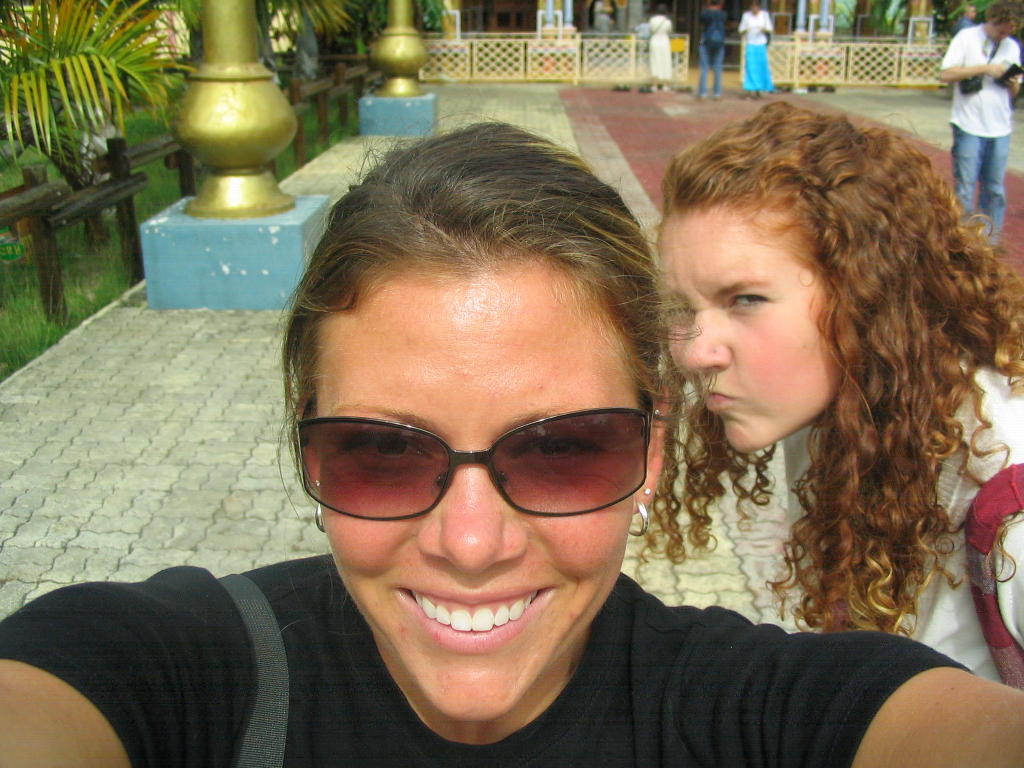
I was going to try to upload a bunch of pictures, but turns out I'm not patient enough. It's time to meet everyone for breakfast and hopefully within two hours I will be out on the streets of India. Our ship just arrived now it's a matter of waiting to clear customs. This picture, by the way, is of Anna and I when we went on our "multi-cultural tour" in Mauritius. In the background you can vaguely see a Chinese pagoda.
K, time to go get excited.
Monday, October 17, 2005
First off can I just say that I’m in a good mood? Why you ask? Well first off, understand that internet on the ship cost 40 cents a minute…yeah, pretty ridiculous. And for the next three days it’s free!! Such a big deal. I’m usually too cheap to check my email so the fact that I might even get to chat online is pretty exciting.
And my iTunes suddenly started working again yesterday. It’s been down for the last month and a half and in turn I haven’t had access to my favorite music. All 5000 songs are accessible once again!
And Sea Olympics was yesterday and out of the eight competing “seas” of people, my sea, the Aegean Sea won!! But more on that in a minute…
And my Japan midterm is finished. Haven’t yet received the grade on it, but regardless, it’s over with.
And last but definitely not least, I’ll be in India on Wednesday. I’ve wanted to go to India for so long and it’s such a big deal to me that it hasn’t hit me yet. I’ve been too caught with papers, exams, and readings, but trust me, in the next couple days I’ll find more time to think, hopefully, and then it will really hit me. After India we’re on the ship for one day and then we hit Burma. So cool.
Okay, so yeah. Sea Olympics were yesterday. The ship is split up into “seas,” and in my case, because my floor has so few people, our sea is the entire 2nd floor student community. I should break down who is on the second floor but that would take too long. But know that the people to sign up for Semester at Sea and pay their deposit last our on the bottom floor of the ship, aka our floor. So there is a higher ratio of boys on our floor than on any other ship and in general we joke that we’re an irresponsible, poor floor. Oh and our floor is made up of a bunch of “ballers.” No joke.
Our sea color was white and we called ourselves the “Tightie Whities” although we never referred to our team name and I’m pretty sure everyone thought we were the “White Tees.” I’m trying to figure out how to best describe our sea in comparison with the rest of the ship. Okay so at the opening ceremonies/talent show the night before the Olympics, all the seas sat in sections in the Union, cheering and chanting and what not. Our cheer? It consisted of one of our guys walking around with speakers in his hands that were attached to an iPod. The rap song “Slang in my white tee” blasted out of it as he danced around our section, attempting to pump us up. We basically cheered “Yep in my white tee!” a million times over the music as the guys danced around and bobbed their heads like they were thugs. There was more to our cheer like, “Portholed in my white tee, Bold in my white tee, Whole Aegean Sea getting gold in my white tee,” but everyone kept getting lost with how many “Yeps” we had said so it fell apart. Oh and our other cheer was “Who let the dogs out? A-G-AN Sea!” So yeah, we were the ballers of the ship. There were two groups on our sea, there were the guys who were our captains and all their friends on the floor, and the rest of us who obviously had not picked out the chant or helped plan our skit which apparently was too racey according to one of our deans. But the talent show and the Olympics were fun regardless. And our team did end up winning so I can’t complain too much.
Oh, but the talent show. It was awesome. Each sea had to do two skits or talents and there was such a variety of things performed. There were a million hilarious Dr. Murphy impersonations (he’s our global studies professor). All the faculty and staff on the ship plus the adult passengers and kids of teachers were part of a competing sea. They made a short film for their talent about “The Truth Behind Semester at Sea”. It was about how all the teachers and faculty were acting and how they had all auditioned for roles before the voyage began. It was pretty funny. One boy was a stand-up comedian. Some girl sang a song on her guitar about finding a condom in her rice and a tampon in the pool. The chorus to the song was “Let this me a message to you kids on this ship. You’re can’t flush anything down that isn’t…” There were team dances and skits too. One of the girls from our floor, Arian, sang opera as that is what she studies at her home school and then a group of people redid the music video for “Call on Me” and did sexual aerobic moves.
The actual Olympics lasted all day yesterday. There were so many competitions. There was a mashed potato sculpture contest, limbo, checkers, tug of war, twister, monopoly, texas hold em, a relay race, pictionary, a scavenger hunt, ping pong, lemonade beer pong, etc. There was even a synchronized swimming competition. Weather was bad, however, so it ended up being held in the Union instead of the swimming pool. But it was still awesome. Some seas really put a lot of effort into their acts. Kathryn was supposed to represent our sea for women’s basketball but it was postponed due to rain.
I signed up for Pictionary, one of the few competitions that our sea did poorly in. I think we got like 6th our of 8 teams and the only reason we didn’t get last is because two seas forfeited at the end because they didn’t want to go through another round.
At the end of the day everyone gathered in the Union to watch the synchronized swimmers and find out the results for the day. They started with 8th place, then 7th, and so on. Each time they didn’t say our teams name I got excited. “Woah, so we at least got fifth place!” I would say each time we weren’t called. It was down to our sea and the Bering Sea at the end and when they announced our name so much cheering and screaming commenced. Soon enough the intro to “Slang in my white tee” was playing and we were rapping our chant again. The guys on our team had been so rowdy the entire time, almost embarrassingly so, so I was happy for them when we won…and, of course, I was happy for myself because by winning that means our sea gets to get off the ship first when we arrive to San Diego in December. Disembarking everyone will take like 8 hours so to get off right away is a big deal.
So now it’s back to classes.
The ships been pretty rocky lately because of long swells. The other day during lunch I was watching my pear roll back and forth on the table as our ship rocked back and forth and about twenty feet away from me I watched as this cart full of pitchers of ice cold water began rolling across the carpet. “Oh my god,” I said quietly, “Oh my god!” I shouted to my friends at the table as the cart hit the back of a boy’s chair and numerous water pitchers poured all down his back. He didn’t even see it coming. “You have got to be kidding me!” he said as he got up quickly. I was laughing so hard I was crying.
We set our clocks ahead 30 minutes last night. Crazy, huh? So now I’m 10 and a half hours ahead of Chicago time…I think. Something like that. On the 24th I will be exactly on the other side of the world.
So yeah, everything is going great here. I’m living one day at a time but still looking forward to India and the countries that follow. Hope all is well back home.
Much love.
Oh and P.S. the whole internet thing? Turns out it’s ridiculously slow. Painfully slow. It’s not even worth the being free.
And my iTunes suddenly started working again yesterday. It’s been down for the last month and a half and in turn I haven’t had access to my favorite music. All 5000 songs are accessible once again!
And Sea Olympics was yesterday and out of the eight competing “seas” of people, my sea, the Aegean Sea won!! But more on that in a minute…
And my Japan midterm is finished. Haven’t yet received the grade on it, but regardless, it’s over with.
And last but definitely not least, I’ll be in India on Wednesday. I’ve wanted to go to India for so long and it’s such a big deal to me that it hasn’t hit me yet. I’ve been too caught with papers, exams, and readings, but trust me, in the next couple days I’ll find more time to think, hopefully, and then it will really hit me. After India we’re on the ship for one day and then we hit Burma. So cool.
Okay, so yeah. Sea Olympics were yesterday. The ship is split up into “seas,” and in my case, because my floor has so few people, our sea is the entire 2nd floor student community. I should break down who is on the second floor but that would take too long. But know that the people to sign up for Semester at Sea and pay their deposit last our on the bottom floor of the ship, aka our floor. So there is a higher ratio of boys on our floor than on any other ship and in general we joke that we’re an irresponsible, poor floor. Oh and our floor is made up of a bunch of “ballers.” No joke.
Our sea color was white and we called ourselves the “Tightie Whities” although we never referred to our team name and I’m pretty sure everyone thought we were the “White Tees.” I’m trying to figure out how to best describe our sea in comparison with the rest of the ship. Okay so at the opening ceremonies/talent show the night before the Olympics, all the seas sat in sections in the Union, cheering and chanting and what not. Our cheer? It consisted of one of our guys walking around with speakers in his hands that were attached to an iPod. The rap song “Slang in my white tee” blasted out of it as he danced around our section, attempting to pump us up. We basically cheered “Yep in my white tee!” a million times over the music as the guys danced around and bobbed their heads like they were thugs. There was more to our cheer like, “Portholed in my white tee, Bold in my white tee, Whole Aegean Sea getting gold in my white tee,” but everyone kept getting lost with how many “Yeps” we had said so it fell apart. Oh and our other cheer was “Who let the dogs out? A-G-AN Sea!” So yeah, we were the ballers of the ship. There were two groups on our sea, there were the guys who were our captains and all their friends on the floor, and the rest of us who obviously had not picked out the chant or helped plan our skit which apparently was too racey according to one of our deans. But the talent show and the Olympics were fun regardless. And our team did end up winning so I can’t complain too much.
Oh, but the talent show. It was awesome. Each sea had to do two skits or talents and there was such a variety of things performed. There were a million hilarious Dr. Murphy impersonations (he’s our global studies professor). All the faculty and staff on the ship plus the adult passengers and kids of teachers were part of a competing sea. They made a short film for their talent about “The Truth Behind Semester at Sea”. It was about how all the teachers and faculty were acting and how they had all auditioned for roles before the voyage began. It was pretty funny. One boy was a stand-up comedian. Some girl sang a song on her guitar about finding a condom in her rice and a tampon in the pool. The chorus to the song was “Let this me a message to you kids on this ship. You’re can’t flush anything down that isn’t…” There were team dances and skits too. One of the girls from our floor, Arian, sang opera as that is what she studies at her home school and then a group of people redid the music video for “Call on Me” and did sexual aerobic moves.
The actual Olympics lasted all day yesterday. There were so many competitions. There was a mashed potato sculpture contest, limbo, checkers, tug of war, twister, monopoly, texas hold em, a relay race, pictionary, a scavenger hunt, ping pong, lemonade beer pong, etc. There was even a synchronized swimming competition. Weather was bad, however, so it ended up being held in the Union instead of the swimming pool. But it was still awesome. Some seas really put a lot of effort into their acts. Kathryn was supposed to represent our sea for women’s basketball but it was postponed due to rain.
I signed up for Pictionary, one of the few competitions that our sea did poorly in. I think we got like 6th our of 8 teams and the only reason we didn’t get last is because two seas forfeited at the end because they didn’t want to go through another round.
At the end of the day everyone gathered in the Union to watch the synchronized swimmers and find out the results for the day. They started with 8th place, then 7th, and so on. Each time they didn’t say our teams name I got excited. “Woah, so we at least got fifth place!” I would say each time we weren’t called. It was down to our sea and the Bering Sea at the end and when they announced our name so much cheering and screaming commenced. Soon enough the intro to “Slang in my white tee” was playing and we were rapping our chant again. The guys on our team had been so rowdy the entire time, almost embarrassingly so, so I was happy for them when we won…and, of course, I was happy for myself because by winning that means our sea gets to get off the ship first when we arrive to San Diego in December. Disembarking everyone will take like 8 hours so to get off right away is a big deal.
So now it’s back to classes.
The ships been pretty rocky lately because of long swells. The other day during lunch I was watching my pear roll back and forth on the table as our ship rocked back and forth and about twenty feet away from me I watched as this cart full of pitchers of ice cold water began rolling across the carpet. “Oh my god,” I said quietly, “Oh my god!” I shouted to my friends at the table as the cart hit the back of a boy’s chair and numerous water pitchers poured all down his back. He didn’t even see it coming. “You have got to be kidding me!” he said as he got up quickly. I was laughing so hard I was crying.
We set our clocks ahead 30 minutes last night. Crazy, huh? So now I’m 10 and a half hours ahead of Chicago time…I think. Something like that. On the 24th I will be exactly on the other side of the world.
So yeah, everything is going great here. I’m living one day at a time but still looking forward to India and the countries that follow. Hope all is well back home.
Much love.
Oh and P.S. the whole internet thing? Turns out it’s ridiculously slow. Painfully slow. It’s not even worth the being free.
Thursday, October 13, 2005
Mauritius!!
So I will be in India on Wednesday. Do you even realize how excited I am? Between the two-day homestay and the overnight visit I have at a Dalit village, my days should be pretty awesome.
We’re back at sea but I spent Sunday through Tuesday on the island of Mauritius. I once again crawled out of bed to see the sun rise as we arrived into port. It was probably one of the most beautiful sun rises I have ever seen, which isn’t as amazing as it sounds, since I have seen very few…but all the same, very beautiful. I spent my first day doing an SAS trip. There were about forty of us that visited this SOS village on the island. Standing for “Save Our Souls”, the purpose of SOS is to provide a normal home-environment for orphaned children. There are SOS villages all over the world. There were forty-two children at the this particular one, and they were divided into groups of six. The children live in a home on the property with their “siblings”, and a woman who looks after them and is referred to as their mother. The set-up was much nicer than I had expected. Concrete square homes with flat roofs lined a short sidewalk and a fence ran around the entire settlement. The children ran around, excited to show us their homes. As a group of us received a tour of one of the houses, three young boys stood in their bedroom, proud to show us where they lived. The bedrooms were filled with bunk-beds and shelves with neatly folded clothing.
Outside, some boys sat on a skateboard and pushed each other down the sloped sidewalk, and children brought out their toys to play with us. We hung around for about an hour after our tour. Everyone, including the children, gathered in one of the main buildings and we handed out the coloring books, crayons, stickers, and other gifts that had been donated by Semester at Sea kids. I sat on the floor for quite some time with this adorable little Indian girl who was about 7-years-old. Her dark black hair was in a bowl cut, much like her older sisters, who looked exactly like her. I had handed her a coloring book and some crayons and although there was a definite language barrier, all the children speak Creole and French, we were able to color together. She actually knew how to say some of the colors in English, I was impressed.
At noon it was time to head out so we said our goodbyes and boarded our buses. The little girl I had colored with was standing outside, in her red T-shirt and denim skirt, and when her eyes fell on me they lit up and she waved. I blew her a kiss and soon our buses were rolling towards our next destination.
We drove to Casela Nature Park for lunch and to spend a couple hours. Apparently Casela used to be an exotic bird-sanctuary and, in my opinion, it still looked like one. Cages upon cages of birds were lined up among the thick trees, underneath the shade. I find it hard to look at birds for a long period of time and was quickly bored by them, but overall the park was still pretty awesome. It reminded me of a large petting zoo. One fenced in area had rooster, deer, a hog, ducks, and even an albino wallaby, walking around. I tip-toed around the massive amounts of pellets laying on the grass. One SAS boy had told us as we entered, “Hope you like stepping in shit!” In a shed along-side the petting area a huge white bird was whistling a familiar tune. I got a kick out of it and roamed over. Before I knew it the bird was leaning towards me, waiting to be petted (mom would it be pet or petted?), and soon enough he was on my arm, digging his large claws into my bare skin. My favorite part of the park was, without a doubt, the monkey cage. About a dozen tiny monkeys were swinging around, picking up small pieces of food from the ground, and grooming one another. I love monkeys, so they totally rocked my world.
When it was time to leave the park I was ready. I hadn’t gotten much sleep the night before and needed a nap badly. Back at the ship I crashed instantly and woke up an hour and a half later to go out to dinner. We ate at a local Indian restaurant that further assisted in my loving of Indian food.
On day two I once again did an SAS trip. Anna and I had signed up for the Multi-cultural tour together and as Anna put it “I just assumed because we were doing it that everyone would be doing it because we’re that cool,” but instead, only three other students besides the two of us signed up for the tour. Fifteen teachers and adult passengers joined us, however. I was actually really happy about it. It made the trip that much quieter, I had a chance to meet other teachers on the ship, and Dean Beverly was impressed with our signing up for an educational tour while everyone else was at the beach. A lot of SASers did the beach all three days they were in Mauritius and never saw the rest of the island or learned anything about the unique blend of cultures that exists. I figured that since I was on this random island I know nothing about, I should take the opportunity to learn as much as I can.
So anyway, as we were boarding our bus that morning I noticed that same woman as yesterday ushering us onto the vehicle. We had the same tour guide as the day before. I couldn’t help but laugh. She had nearly given me a migraine the day before as her voice blared over the bus speakers and in her monotone voice she explained all nine regions of the island one at a time. So when she picked up the same map of the island on Monday and began her schpeal I had to close my eyes to get ready. Anna nudged me with a grin, she too had experience our guide the day before.
During the day tour we went to a variety of places. We visited Kalysson, a Hindu temple; drove up to this awesome look-out point above Port Louis and through China town; visited a Chinese pagoda; and received a tour of some old colonial home. I actually had no idea what was going on at the colonial house, as far as the story behind it went. I fell into a deep sleep between the Chinese pagoda and the colonial home and woke up just as we arrived to our destination. I was so out of it that I climbed out of the bus and followed our group around the area for a good ten minutes before I turned to Anna and asked, “Where are we?”
We ate lunch at the colonial house and as most meals on SAS trips are, it was amazing. The afternoon was then spent at the Mahatma Gandhi Institute. The institute is essentially a secondary school that focuses on Indian culture. Classes include Indian languages and dance, music, and art related to the culture. Fifty percent of Mauritius is Indian, by the way, so Indian culture is a pretty big part of society.
After the head of the school stood before us and answered multiple questions that the teachers had about the institution, we were given a tour of the facilities. On one floor, there were four different rooms at the top of the stairs, and in each room music or dance was being both taught and practiced. I removed my shoes before entering the first room. Inside five people sat cross-legged on a rug looking up at a dry erase board that had lyrics to a song, “Ma pa ga di re sa” it said and so on. The teacher, who sat on the floor as well, had a sitar across his lap and was working on teaching specific rhythms to his students. He invited us to join them in their song. So we sat along side them and attempted to figure out the tune as the sitar played underneath our voices. It was really cool.
In the next room five college-aged students sat on the ground with music sitting in front of them. They sang a beautiful Indian song while one student strummed a sitar and two men rolled their fingers over small drums. I watched them for quite some time and the song is still stuck in my head. I visited one more classroom before we moved on to see some more of the institute. In the last classroom were two teenage girls dressed in saris holding their shoulders back as they worked on the basics of Indian dance. An older woman sat on the ground, tapping a wooden box loudly as she instructed them on their moves.
The rest of the institution was interesting, but we mainly walked through an agricultural museum that was extremely similar to something you’d see in the U.S…nothing too interesting.
Wednesday morning I woke up and wished so badly I could sleep for just a couple more hours, but once I remembered that it was a beach day I was able to pull myself out of bed. Carrie, Kathryn, Anna, Janelle and I took a city bus, or I guess island bus, to Flick en Flack beach, on the south side of the island. The ride there was interesting. Our driver sped along, passing vehicles as oncoming traffic approached. I eventually stopped watching the road and the ride was much more enjoyable. A man who was getting off the bus felt my hair and smiled at me as he passed. Hmm.
So we got to the beach and walked for quite some time before finally picking a spot to lay out our towels. Other SASers who had stayed at one of the beach resorts were drunk about a quarter of a mile down the beach from us and we made a strong attempt to stay at a distance from their obtrusive yelling. I get really bothered when other SASers are belligerent in public when we’re in these foreign countries, it totally misrepresents the ship and our country. On the way home that day we took the bus again and about seven other students sat in the back of the bus, still drunk and talking loudly so that their conversations were above everyone elses. As we passed a bus station one boy said loudly, “Oooo can we stop and get some beer?”
But anyway, the beach day was nice. It was beautiful outside, the skies were blue and a slight breeze kept us from melting in the hot sun. I tried reading some of my assignments when we first got there but decided I should relax for once and enjoy my time at the beach. Anna, Janelle, and I left at 3:00, an hour earlier than Carrie and Kathryn. On the way out we bought some pineapples from a street vendor. They were prepeeled, of however they do that, and flipped upside down so you ate the small pineapple like an icecream bar. Oh my gosh it was amazing. I shouldn’t have eaten fruit that I didn’t peel myself and I should be eating food from street vendors, but I couldn’t resist and the worse I’ll get is traveler’s diarrhea. Been there, done that…it’s worth it.
Anna, Janelle, and I shopped around the waterfront area when we got back. We eventually decided to sit down for dinner and ended up at an outdoor café, eating pizza with pineapple and green peppers on it, not as bad as it sounds. We hopped back on the water taxi and made it made to the ship with plenty of time to spare before dock time became an issue. Oh yeah, did I mention that we took water taxis like a million times while in Mauritius? To get to the waterfront, where all the restaurants, shops, and buses are, from the ship, we had to ride a small motor boat for about three minutes across the harbour. It was convenient, cost a dollar, and was sort of fun, in my opinion.
All is well here. We had our second global studies exam last week and I got 49 out of 50 right…I’m pretty proud. I’ve been working on three different papers and I have a Japan midterm in two days, so I’ve been, and will continue to, stay busy with homework until we reach India. Sometimes I feel like I’m constantly doing homework on this ship. Last night I worked for four straight hours on a paper about earthquakes…it was torture. Luckily, Sea Olympics are Sunday and we have no classes for the day…I’m participating in the Pictionary event: ) Wish me luck.
We’re back at sea but I spent Sunday through Tuesday on the island of Mauritius. I once again crawled out of bed to see the sun rise as we arrived into port. It was probably one of the most beautiful sun rises I have ever seen, which isn’t as amazing as it sounds, since I have seen very few…but all the same, very beautiful. I spent my first day doing an SAS trip. There were about forty of us that visited this SOS village on the island. Standing for “Save Our Souls”, the purpose of SOS is to provide a normal home-environment for orphaned children. There are SOS villages all over the world. There were forty-two children at the this particular one, and they were divided into groups of six. The children live in a home on the property with their “siblings”, and a woman who looks after them and is referred to as their mother. The set-up was much nicer than I had expected. Concrete square homes with flat roofs lined a short sidewalk and a fence ran around the entire settlement. The children ran around, excited to show us their homes. As a group of us received a tour of one of the houses, three young boys stood in their bedroom, proud to show us where they lived. The bedrooms were filled with bunk-beds and shelves with neatly folded clothing.
Outside, some boys sat on a skateboard and pushed each other down the sloped sidewalk, and children brought out their toys to play with us. We hung around for about an hour after our tour. Everyone, including the children, gathered in one of the main buildings and we handed out the coloring books, crayons, stickers, and other gifts that had been donated by Semester at Sea kids. I sat on the floor for quite some time with this adorable little Indian girl who was about 7-years-old. Her dark black hair was in a bowl cut, much like her older sisters, who looked exactly like her. I had handed her a coloring book and some crayons and although there was a definite language barrier, all the children speak Creole and French, we were able to color together. She actually knew how to say some of the colors in English, I was impressed.
At noon it was time to head out so we said our goodbyes and boarded our buses. The little girl I had colored with was standing outside, in her red T-shirt and denim skirt, and when her eyes fell on me they lit up and she waved. I blew her a kiss and soon our buses were rolling towards our next destination.
We drove to Casela Nature Park for lunch and to spend a couple hours. Apparently Casela used to be an exotic bird-sanctuary and, in my opinion, it still looked like one. Cages upon cages of birds were lined up among the thick trees, underneath the shade. I find it hard to look at birds for a long period of time and was quickly bored by them, but overall the park was still pretty awesome. It reminded me of a large petting zoo. One fenced in area had rooster, deer, a hog, ducks, and even an albino wallaby, walking around. I tip-toed around the massive amounts of pellets laying on the grass. One SAS boy had told us as we entered, “Hope you like stepping in shit!” In a shed along-side the petting area a huge white bird was whistling a familiar tune. I got a kick out of it and roamed over. Before I knew it the bird was leaning towards me, waiting to be petted (mom would it be pet or petted?), and soon enough he was on my arm, digging his large claws into my bare skin. My favorite part of the park was, without a doubt, the monkey cage. About a dozen tiny monkeys were swinging around, picking up small pieces of food from the ground, and grooming one another. I love monkeys, so they totally rocked my world.
When it was time to leave the park I was ready. I hadn’t gotten much sleep the night before and needed a nap badly. Back at the ship I crashed instantly and woke up an hour and a half later to go out to dinner. We ate at a local Indian restaurant that further assisted in my loving of Indian food.
On day two I once again did an SAS trip. Anna and I had signed up for the Multi-cultural tour together and as Anna put it “I just assumed because we were doing it that everyone would be doing it because we’re that cool,” but instead, only three other students besides the two of us signed up for the tour. Fifteen teachers and adult passengers joined us, however. I was actually really happy about it. It made the trip that much quieter, I had a chance to meet other teachers on the ship, and Dean Beverly was impressed with our signing up for an educational tour while everyone else was at the beach. A lot of SASers did the beach all three days they were in Mauritius and never saw the rest of the island or learned anything about the unique blend of cultures that exists. I figured that since I was on this random island I know nothing about, I should take the opportunity to learn as much as I can.
So anyway, as we were boarding our bus that morning I noticed that same woman as yesterday ushering us onto the vehicle. We had the same tour guide as the day before. I couldn’t help but laugh. She had nearly given me a migraine the day before as her voice blared over the bus speakers and in her monotone voice she explained all nine regions of the island one at a time. So when she picked up the same map of the island on Monday and began her schpeal I had to close my eyes to get ready. Anna nudged me with a grin, she too had experience our guide the day before.
During the day tour we went to a variety of places. We visited Kalysson, a Hindu temple; drove up to this awesome look-out point above Port Louis and through China town; visited a Chinese pagoda; and received a tour of some old colonial home. I actually had no idea what was going on at the colonial house, as far as the story behind it went. I fell into a deep sleep between the Chinese pagoda and the colonial home and woke up just as we arrived to our destination. I was so out of it that I climbed out of the bus and followed our group around the area for a good ten minutes before I turned to Anna and asked, “Where are we?”
We ate lunch at the colonial house and as most meals on SAS trips are, it was amazing. The afternoon was then spent at the Mahatma Gandhi Institute. The institute is essentially a secondary school that focuses on Indian culture. Classes include Indian languages and dance, music, and art related to the culture. Fifty percent of Mauritius is Indian, by the way, so Indian culture is a pretty big part of society.
After the head of the school stood before us and answered multiple questions that the teachers had about the institution, we were given a tour of the facilities. On one floor, there were four different rooms at the top of the stairs, and in each room music or dance was being both taught and practiced. I removed my shoes before entering the first room. Inside five people sat cross-legged on a rug looking up at a dry erase board that had lyrics to a song, “Ma pa ga di re sa” it said and so on. The teacher, who sat on the floor as well, had a sitar across his lap and was working on teaching specific rhythms to his students. He invited us to join them in their song. So we sat along side them and attempted to figure out the tune as the sitar played underneath our voices. It was really cool.
In the next room five college-aged students sat on the ground with music sitting in front of them. They sang a beautiful Indian song while one student strummed a sitar and two men rolled their fingers over small drums. I watched them for quite some time and the song is still stuck in my head. I visited one more classroom before we moved on to see some more of the institute. In the last classroom were two teenage girls dressed in saris holding their shoulders back as they worked on the basics of Indian dance. An older woman sat on the ground, tapping a wooden box loudly as she instructed them on their moves.
The rest of the institution was interesting, but we mainly walked through an agricultural museum that was extremely similar to something you’d see in the U.S…nothing too interesting.
Wednesday morning I woke up and wished so badly I could sleep for just a couple more hours, but once I remembered that it was a beach day I was able to pull myself out of bed. Carrie, Kathryn, Anna, Janelle and I took a city bus, or I guess island bus, to Flick en Flack beach, on the south side of the island. The ride there was interesting. Our driver sped along, passing vehicles as oncoming traffic approached. I eventually stopped watching the road and the ride was much more enjoyable. A man who was getting off the bus felt my hair and smiled at me as he passed. Hmm.
So we got to the beach and walked for quite some time before finally picking a spot to lay out our towels. Other SASers who had stayed at one of the beach resorts were drunk about a quarter of a mile down the beach from us and we made a strong attempt to stay at a distance from their obtrusive yelling. I get really bothered when other SASers are belligerent in public when we’re in these foreign countries, it totally misrepresents the ship and our country. On the way home that day we took the bus again and about seven other students sat in the back of the bus, still drunk and talking loudly so that their conversations were above everyone elses. As we passed a bus station one boy said loudly, “Oooo can we stop and get some beer?”
But anyway, the beach day was nice. It was beautiful outside, the skies were blue and a slight breeze kept us from melting in the hot sun. I tried reading some of my assignments when we first got there but decided I should relax for once and enjoy my time at the beach. Anna, Janelle, and I left at 3:00, an hour earlier than Carrie and Kathryn. On the way out we bought some pineapples from a street vendor. They were prepeeled, of however they do that, and flipped upside down so you ate the small pineapple like an icecream bar. Oh my gosh it was amazing. I shouldn’t have eaten fruit that I didn’t peel myself and I should be eating food from street vendors, but I couldn’t resist and the worse I’ll get is traveler’s diarrhea. Been there, done that…it’s worth it.
Anna, Janelle, and I shopped around the waterfront area when we got back. We eventually decided to sit down for dinner and ended up at an outdoor café, eating pizza with pineapple and green peppers on it, not as bad as it sounds. We hopped back on the water taxi and made it made to the ship with plenty of time to spare before dock time became an issue. Oh yeah, did I mention that we took water taxis like a million times while in Mauritius? To get to the waterfront, where all the restaurants, shops, and buses are, from the ship, we had to ride a small motor boat for about three minutes across the harbour. It was convenient, cost a dollar, and was sort of fun, in my opinion.
All is well here. We had our second global studies exam last week and I got 49 out of 50 right…I’m pretty proud. I’ve been working on three different papers and I have a Japan midterm in two days, so I’ve been, and will continue to, stay busy with homework until we reach India. Sometimes I feel like I’m constantly doing homework on this ship. Last night I worked for four straight hours on a paper about earthquakes…it was torture. Luckily, Sea Olympics are Sunday and we have no classes for the day…I’m participating in the Pictionary event: ) Wish me luck.
Thursday, October 06, 2005
Yesterday in global studies we watched this documentary on AIDS in Kenya called “Left Behind.” It was made by a college student who had volunteered at an AIDS orphanage in Kenya. He interviewed children and adults from the orphanage and neighboring slum town. It was probably one of the saddest films I have ever seen. When asked, one boy who was dieing of aids thought that he caught the virus from glue sniffing when he used to live on the streets. Other children in the orphanage knew very little about the virus. The abandoned children living in the streets weren’t sure how it was transmitted either. One boy thought it was from “being kicked”, others thought companies put drops of HIV into condoms.
The documentary taught us that over 100,000 children are homeless on the streets because their parents have died of AIDS. These children have nothing to eat and sniff glue in order to forget their hunger. On top of that most of them are having sex, even though they are like thirteen-years-old or even younger, therefore increasing their chances of getting AIDS. The guy who made the documentary asked one boy what he missed most about his mother. The homeless boy, although tough looking, got quiet and wiped tears from his eyes, finally saying “She helped me with things,” before another boy spoke up, explaining that he was crying because he loved his mother so much.
On another side of the spectrum, prostitutes were interviewed. These women said they had been with over a thousand men, many without condoms, in order to get food for their children. One woman was asked what would happen to her children if she were to get AIDS and die. She explained that if she dies then they won’t expect her to feed them anymore. But right now as their mother they look to her for food and she has can’t tell them that she has nothing because she is their mother and it is her duty. Another scene showed a woman on the side of the road, beaten to a bloody pulp and surrounded by people looking on. The college kid filming said under his breath “Jesus Christ” over and over as he taped. Apparently the woman had asked her husband to use a condom and he had taken it as a sign that she doesn’t trust him so he got his friends together to teach her a lesson. After being beaten her husband helped her stand up and took her back home. The documentary made everything so real and pointed out that although he got to go home after his stay in Kenya, the homeless boys are still roaming the streets and AIDS is still spreading rapidly. Once again, it was really a disturbing movie.
When the film was over Professor Murphy left us with a quote I can not remember at this time, and left us leave. No one really talked, instead everyone shuffled out of the union quietly. I heard Jed, a boy I vaguely know, talking to another person behind me, “It’s hard to see all of that and be stuck on a ship and have to go to class and not do something. And know that I probably never will do something,” he said in defeat. As I walked down the five flights of stairs to my room I saw one girl, red faced, being comforted by a friend. Anyway, I definitely had a “thank god I’m seeing this side of our world” moment yesterday morning.
And then last night I went to a discussion about Myanmar with one of my teachers and the academic dean. I’m anxious to finish my book on Burma and learn more about the military regime ruling the country. It’s so upsetting, especially because so few people know about what is going on there. It’s all so hidden.
So yeah, learned a lot yesterday. Also, once again, got no nap in…that makes it three days in a row now! My roomie is impressed. Sea TV is taking up all my time, but I’m getting used to it. All is well, hope it is in Illinois too.
The documentary taught us that over 100,000 children are homeless on the streets because their parents have died of AIDS. These children have nothing to eat and sniff glue in order to forget their hunger. On top of that most of them are having sex, even though they are like thirteen-years-old or even younger, therefore increasing their chances of getting AIDS. The guy who made the documentary asked one boy what he missed most about his mother. The homeless boy, although tough looking, got quiet and wiped tears from his eyes, finally saying “She helped me with things,” before another boy spoke up, explaining that he was crying because he loved his mother so much.
On another side of the spectrum, prostitutes were interviewed. These women said they had been with over a thousand men, many without condoms, in order to get food for their children. One woman was asked what would happen to her children if she were to get AIDS and die. She explained that if she dies then they won’t expect her to feed them anymore. But right now as their mother they look to her for food and she has can’t tell them that she has nothing because she is their mother and it is her duty. Another scene showed a woman on the side of the road, beaten to a bloody pulp and surrounded by people looking on. The college kid filming said under his breath “Jesus Christ” over and over as he taped. Apparently the woman had asked her husband to use a condom and he had taken it as a sign that she doesn’t trust him so he got his friends together to teach her a lesson. After being beaten her husband helped her stand up and took her back home. The documentary made everything so real and pointed out that although he got to go home after his stay in Kenya, the homeless boys are still roaming the streets and AIDS is still spreading rapidly. Once again, it was really a disturbing movie.
When the film was over Professor Murphy left us with a quote I can not remember at this time, and left us leave. No one really talked, instead everyone shuffled out of the union quietly. I heard Jed, a boy I vaguely know, talking to another person behind me, “It’s hard to see all of that and be stuck on a ship and have to go to class and not do something. And know that I probably never will do something,” he said in defeat. As I walked down the five flights of stairs to my room I saw one girl, red faced, being comforted by a friend. Anyway, I definitely had a “thank god I’m seeing this side of our world” moment yesterday morning.
And then last night I went to a discussion about Myanmar with one of my teachers and the academic dean. I’m anxious to finish my book on Burma and learn more about the military regime ruling the country. It’s so upsetting, especially because so few people know about what is going on there. It’s all so hidden.
So yeah, learned a lot yesterday. Also, once again, got no nap in…that makes it three days in a row now! My roomie is impressed. Sea TV is taking up all my time, but I’m getting used to it. All is well, hope it is in Illinois too.
Tuesday, October 04, 2005
South Africa!!
I’m back on the ship and after a week in Cape Town I find myself having trouble adjusting to the idea that I have to go back to my classes, finish reading assignments, and write papers. Cape Town was awesome. I did so much in the course of the seven days I was there but I’m ready to move on to our next port.
So where to start. Well as I already wrote in my last entry, I went skydiving on my first day in South Africa. It was amazing, yada, yada, yada. On Tuesday, my second day, I did a tour of the wine lands with three other people from the ship. We ended up being the only four people in our tour, which was awesome because a lot of the other tours were full of people. Our guide, who’s name was pronounced Air-el, told us, “I want to give you the best…this is your day,” He offered to take us anywhere we wanted to go but we stuck to the plan of drinking lots of wine at four different wineries. Airel talked to us about South Africa’s political situation for quite some time. “It’s our country now, it wasn’t before,” he explained, telling us stories about how much life has changed since apartheid ended. Hearing him speak about Nelson Mandela was really interesting for me. He kept stressing about how wonderful Mandela is, “When he is near you you get goosebumps…he is that great of a person,” he told us with excitement.
Our tour consisted of Airel driving the four of us around to different wineries, where we had the opportunity to taste up to five different types of wine. I knew very little about wine tasting, and still don’t understand how on earth winetasters find so many different flavors within a single glass of wine. I guess my palette isn’t developed enough yet. But all the same, I really enjoyed pretending that I noticed a major difference between each glass.
On Wednesday I went on a Semester at Sea trip to a township outside of Cape Town. Our tour first took us to the District Six Museum which made my day because I was really disappointed that I wasn’t going to have the time to visit it while in South Africa. District Six is an area where 70,000 blacks were removed, starting in 1972, in order to make way for Europeans. Homes were bulldozed and entire neighborhoods turned to ruins. Members of the community ended up in squatter camps and homeless. The museum showed what the neighborhood once looked like, had testimonies displayed from past residents, and had a map of the district that covered the entire first floor. People had written small comments and signed their names where their homes once stood. Our tour guide himself once lived in District Six. His grandfather down to his son was born in the house that was bulldozed right before his eyes.
After the museum visit our bus headed to a township, or a squatter camp. Although apartheid is over, consequences of it still remain. Thousands upon thousands of blacks live in shanties crammed together, some without doors. Before we entered the township our bus driver told us, “This may be emotional for you, but it is our past and we are looking to the future.”
Upon entering the township our motorcoach drove up and down the streets, showing us the intensive amount of poverty that exists in South Africa. If one were to visit Cape Town they would not see this side of the wealth distribution. Cape Town is made up primarly of white middle-class citizens. So anyway, children were running out of their homes, waving at our bus, parents just stared at us and continued their work. One little boy flipped us off and said “Fuck you,” as we drove by. Eventually the bus was parked and we had the opportunity to walk around the township. We received a tour of a bed and breakfast that is essentially a fixed-up shanty. A woman from the township, Vicky, started it in order to bring more people into their neighborhood. We also went to a day-care type place. The day-care was in a shanty as well, hidden from the dirt road and behind several homes. Ten young children were there that day and they sat politely in the tiny room that made up the building, as a woman explained the purpose of the establishment. Before we left they sang a couple songs for us.
After our tour we headed back outside and spent about an hour standing around on the narrow dirt road, talking to children, and walking around. One girl brought a Polaroid camera and was taking children’s pictures, giving them a photograph of themselves, something many of them don’t have. I wish I had thought of that. The kids got a kick out of seeing their faces on the backs of digital cameras though and I found myself plowed over by kids at one point as they asked me to take their picture and laughed when they saw how it turned out. A group of women stood in front of a nearby home, cleaning their clothes in a soapy bucket. Some girls started a game that looked similar to jump-roping but was much more complicated. A little boy in a wheelchair rolled by, being pushed by another child. It was all so overwhelming.
What I found important to note is that these shanties, surrounded by dirt, were spotless. They were swept clean, making it obvious that people took pride in their homes. And the women that were cleaning their clothes were also scrubbing their shoes, something I don’t even do. It was very apparent that the poverty of all these people is out of their control. The unemployment rate in South Africa is up to 40% I believe…maybe 30.
After an hour we loaded back onto our air-conditioned buses and backed out of the township as the children stood outside barefooted on the dirt ground. Students reviewed the pictures they had taken on their digital cameras as these young kids waved at us upon our departure. We are so lucky it’s ridiculous. I just can’t get over it.
Before the tour was over we stopped for lunch at a restaurant located in a different township. This township was nicer as it had paved roads dividing the homes, but the poverty was still evident. The owner of the restaurant, Sheila, told us her story. She worked as a maid, I believe, for quite some time, making only 40 Rand a month, which is equivalent to less than seven dollars American. One day at work she picked up a receipt that the homeowner of the house she was cleaning left out. He had spent 40 Rand the night before on wine and cheese at a restaurant. It then hit her that she was valued the same as some wine and cheese and shortly after she enrolled in night school, which didn’t work out she said because she couldn’t stay awake due to the fact that by then she was working two jobs. Eventually she started a second-hand clothing story and made enough money to start up her own restaurant and add on to her home, which is a part of the restaurant as well. I just found her whole story really interesting. And the food served was awesome, there are about fifteen different dishes for us to taste. While we ate a marimba band performed; they were really talented and the main singer had an amazing voice, very operatic.
I spent my next day in Cape Town sandboarding. There were about fifteen of us and we rode in vans until we reached the sand dunes, which were an hour out of Cape Town. Everyone stepped into a pair of snowboarding boots and carrying a snowboard being our backs, we hiked out into the dunes.
Sandboarding was a good time, but I think it’s more of a sport for those who haven’t snowboarding rather than for those who have. I mean, it’s hard for me to get a rush from sliding down a hill of sand when I’ve snowboarded black diamonds in Colorado, you know? All the same though, it was a good time. One of the guys on the trip, Rob, is a snowboarder as well so the two of us teamed up and attempted to find steeper slopes. Oh and did I mention that we had to hike back up the sand dune after each run? Yeah, it definitely got tiring.
By the time sandboarding was finished at 3:00, we were all starving. A group of us ate lunch at this health food place in the mall. It ended up being my favorite place to eat in Cape Town and I went back like three times.
That night a group of us went out to a restaurant to drink some wine and ended up at two different clubs in the course of the night. It was an awesome time and we got all these free drinks because this guy wanted us to go to the club where he was DJing. So on top of the free drinks we also had free entry into the dance club because he was with us. So cool.
Friday was Table Mountain day. Since arriving in Cape Town, Table Mountain had been impossible to miss, I mean, it sits in the center of the city, towering over it. Carrie, Kathryn, this girl Gretchen who I had just met, and I took a cab to the beginning of one of the hiking trails and started our journey up the mountain. It was hard, really hard and that was only the first half an hour. When we reached a crossroad in the path this man who was resting pointed to the left, saying that the path was easier that way…we were all for it. And it was easy, but only for about an hour. Then it got ridiculously difficult. We were hiking up through this gorge, going back and forth on the same slope as it ascended upwards. Our path way was made entirely up of rocks and it felt like I was doing the stairmaster on level 20. On top of that, Table Mountain has very little vegetation, so there were no trees to give us shade and we were baking in the hot sun. It was so frustrating because for nearly the entire hike we could see our goal, this tiny path that led through the huge rocks at the top of the mountain. I looked at that path so many times, wishing it were just a little closer. We had to stop a lot, especially once we ran out of water, and eventually Kathryn went off on her own and beat us to the top by about thirty minutes. We did make it up there, and the view was a hundred times more spectacular because we had worked so hard to see it. Despite how rewarding the hike had been though, we still opted to take the cable car back down and save time and energy.
At 2:00 we up with these two girls who are studying abroad in Stellenbosch. Carrie knew one of them from her college in Kansas. Gretchen headed back to the ship and the four of went to the well-known botanical gardens in the city. I have no idea how to spell the name of the gardens so I’m not even going to try. As we stood in line getting our entry tickets I there were two older women behind us. I paused between two sentences to hear one woman whisper to the other, “American.” I guess my accent gave me away. My head darted towards them a little too quickly and I soon wished I hadn’t looked their way because they both ended up staring at me. I smirked and turned around as though I shouldn’t have heard them talking. But anyway, the gardens were beautiful. The grass was freshly mowed and children ran around while their mothers laid on blankets underneath the shade of the trees. There were flowers everywhere and strange-looking ducks waddling around near a small pond. Casey and Becky had to get on the train to head back to their school before it became dark so we only got to spend a little over an hour at the gardens and I have a feeling that there was so much more we could have seen if we had had more time to walk further into the park.
On Saturday morning I met this girl Kristen in the dining center for breakfast and then we headed out together to go to Robben Island. I had met Kristen on the township visit and was so happy to hear that she wanted to visit Robben Island on Saturday too. For a while I thought I would be going alone. Robben Island is this small piece of land right off the coast of Cape Town that was used a prison for political prisoners during apartheid. Nelson Mandela spent eighteen years of his life in a cell on the island. It’s a really big tourist attraction now and you have to get tickets days in advance for tours, which are always sold out.
I’m really glad I got to go to Robben Island because I learned so much. We were driven around in buses and saw the areas where the prisoners were forced to work each day. Different animals were scattered around the island, including tiny Jackass Penguins which we hiding underneath the shade of trees. While on the bus tour our guide asked everyone to say what country they were from. I was amazed at the variety of tourists within this one group of people. There were folks from New Zealand, Australia, Brazil, Germany, Ireland, just so many places.
For the second half of the tour we were taken to actually holding cells for the prisoners and a new tour guide explained to us what the prisoners went through on a daily basis. He knew all too well since he himself had been a prisoner in Robben Island for five years, and would have been there longer had not all the prisoners been released in the early 90’s.
In the afternoon Anna and I took a bus to the Green Street Market. Today was my shopping day and because Anna had nothing else to do she offered to come along with me. She was awesome. She helped me carry all my purchases and was so patient with me. I bought a kick-ass drum that I’m really excited about. It rocks my world.
I was up the next morning at 5:30 am for my safari. Only I don’t feel like I can actually call it a safari because in general, it sucked. I mean, I guess it wasn’t that bad, but it wasn’t a safari at all. See, I would have never signed up for a safari in Cape Town if we were going to Kenya but after that port was cancelled I, and hundreds of other students, rushed to sign up for a South African safari.
We boarded a motorcoach at 6:30 am and drove two hours to this area, which I don’t think I can even call a reserve. It was a beautiful drive there, although I slept through most of it. I woke up while we were driving through a mountain pass though and was just amazed at the beauty of the area.
At the lodge they gave us this awesome breakfast, which was probably the highlight of the trip. We then headed out in this safari jeep/van/bus thing with stadium seating in the back. The safari basically consisted of us driving around and looking at animals, which granted were animals I rarely see, such as giraffes, hippos, ostriches, and lions. Only it was so fake because there were fences everywhere and the animals were obviously not roaming free. And there were only like three of every animal. I don’t know. I just know in Kenya we would have been driving around entire parks with loads of animals roaming at their own will. But yeah, we got to go into a cage with some young lions which was pretty cool, but we couldn’t pet them like the brochure had said.
At 3:00 we headed back to Cape Town. I slept the entire way again. Everyone was back on the ship by 9:00 pm and an African Township Choir performed for us in the union before we departed. Oh and yeah I guess we departed without two boys, or maybe three, who were sent home. A fight broke out the night before in front of the ship and both boys were kicked out of the program.
So yep, back on the ship once again. I really enjoyed Cape Town, but I’m ready for Mauritius, and I’m really ready for India.
I’m sick, but it’s nothing serious. Just the usual. I’ve been sick so many times on the trip so I’m starting to get used to it. I skipped my first class yesterday though, it felt amazing.
Anyway, I have papers to write. Hope all is well.
So where to start. Well as I already wrote in my last entry, I went skydiving on my first day in South Africa. It was amazing, yada, yada, yada. On Tuesday, my second day, I did a tour of the wine lands with three other people from the ship. We ended up being the only four people in our tour, which was awesome because a lot of the other tours were full of people. Our guide, who’s name was pronounced Air-el, told us, “I want to give you the best…this is your day,” He offered to take us anywhere we wanted to go but we stuck to the plan of drinking lots of wine at four different wineries. Airel talked to us about South Africa’s political situation for quite some time. “It’s our country now, it wasn’t before,” he explained, telling us stories about how much life has changed since apartheid ended. Hearing him speak about Nelson Mandela was really interesting for me. He kept stressing about how wonderful Mandela is, “When he is near you you get goosebumps…he is that great of a person,” he told us with excitement.
Our tour consisted of Airel driving the four of us around to different wineries, where we had the opportunity to taste up to five different types of wine. I knew very little about wine tasting, and still don’t understand how on earth winetasters find so many different flavors within a single glass of wine. I guess my palette isn’t developed enough yet. But all the same, I really enjoyed pretending that I noticed a major difference between each glass.
On Wednesday I went on a Semester at Sea trip to a township outside of Cape Town. Our tour first took us to the District Six Museum which made my day because I was really disappointed that I wasn’t going to have the time to visit it while in South Africa. District Six is an area where 70,000 blacks were removed, starting in 1972, in order to make way for Europeans. Homes were bulldozed and entire neighborhoods turned to ruins. Members of the community ended up in squatter camps and homeless. The museum showed what the neighborhood once looked like, had testimonies displayed from past residents, and had a map of the district that covered the entire first floor. People had written small comments and signed their names where their homes once stood. Our tour guide himself once lived in District Six. His grandfather down to his son was born in the house that was bulldozed right before his eyes.
After the museum visit our bus headed to a township, or a squatter camp. Although apartheid is over, consequences of it still remain. Thousands upon thousands of blacks live in shanties crammed together, some without doors. Before we entered the township our bus driver told us, “This may be emotional for you, but it is our past and we are looking to the future.”
Upon entering the township our motorcoach drove up and down the streets, showing us the intensive amount of poverty that exists in South Africa. If one were to visit Cape Town they would not see this side of the wealth distribution. Cape Town is made up primarly of white middle-class citizens. So anyway, children were running out of their homes, waving at our bus, parents just stared at us and continued their work. One little boy flipped us off and said “Fuck you,” as we drove by. Eventually the bus was parked and we had the opportunity to walk around the township. We received a tour of a bed and breakfast that is essentially a fixed-up shanty. A woman from the township, Vicky, started it in order to bring more people into their neighborhood. We also went to a day-care type place. The day-care was in a shanty as well, hidden from the dirt road and behind several homes. Ten young children were there that day and they sat politely in the tiny room that made up the building, as a woman explained the purpose of the establishment. Before we left they sang a couple songs for us.
After our tour we headed back outside and spent about an hour standing around on the narrow dirt road, talking to children, and walking around. One girl brought a Polaroid camera and was taking children’s pictures, giving them a photograph of themselves, something many of them don’t have. I wish I had thought of that. The kids got a kick out of seeing their faces on the backs of digital cameras though and I found myself plowed over by kids at one point as they asked me to take their picture and laughed when they saw how it turned out. A group of women stood in front of a nearby home, cleaning their clothes in a soapy bucket. Some girls started a game that looked similar to jump-roping but was much more complicated. A little boy in a wheelchair rolled by, being pushed by another child. It was all so overwhelming.
What I found important to note is that these shanties, surrounded by dirt, were spotless. They were swept clean, making it obvious that people took pride in their homes. And the women that were cleaning their clothes were also scrubbing their shoes, something I don’t even do. It was very apparent that the poverty of all these people is out of their control. The unemployment rate in South Africa is up to 40% I believe…maybe 30.
After an hour we loaded back onto our air-conditioned buses and backed out of the township as the children stood outside barefooted on the dirt ground. Students reviewed the pictures they had taken on their digital cameras as these young kids waved at us upon our departure. We are so lucky it’s ridiculous. I just can’t get over it.
Before the tour was over we stopped for lunch at a restaurant located in a different township. This township was nicer as it had paved roads dividing the homes, but the poverty was still evident. The owner of the restaurant, Sheila, told us her story. She worked as a maid, I believe, for quite some time, making only 40 Rand a month, which is equivalent to less than seven dollars American. One day at work she picked up a receipt that the homeowner of the house she was cleaning left out. He had spent 40 Rand the night before on wine and cheese at a restaurant. It then hit her that she was valued the same as some wine and cheese and shortly after she enrolled in night school, which didn’t work out she said because she couldn’t stay awake due to the fact that by then she was working two jobs. Eventually she started a second-hand clothing story and made enough money to start up her own restaurant and add on to her home, which is a part of the restaurant as well. I just found her whole story really interesting. And the food served was awesome, there are about fifteen different dishes for us to taste. While we ate a marimba band performed; they were really talented and the main singer had an amazing voice, very operatic.
I spent my next day in Cape Town sandboarding. There were about fifteen of us and we rode in vans until we reached the sand dunes, which were an hour out of Cape Town. Everyone stepped into a pair of snowboarding boots and carrying a snowboard being our backs, we hiked out into the dunes.
Sandboarding was a good time, but I think it’s more of a sport for those who haven’t snowboarding rather than for those who have. I mean, it’s hard for me to get a rush from sliding down a hill of sand when I’ve snowboarded black diamonds in Colorado, you know? All the same though, it was a good time. One of the guys on the trip, Rob, is a snowboarder as well so the two of us teamed up and attempted to find steeper slopes. Oh and did I mention that we had to hike back up the sand dune after each run? Yeah, it definitely got tiring.
By the time sandboarding was finished at 3:00, we were all starving. A group of us ate lunch at this health food place in the mall. It ended up being my favorite place to eat in Cape Town and I went back like three times.
That night a group of us went out to a restaurant to drink some wine and ended up at two different clubs in the course of the night. It was an awesome time and we got all these free drinks because this guy wanted us to go to the club where he was DJing. So on top of the free drinks we also had free entry into the dance club because he was with us. So cool.
Friday was Table Mountain day. Since arriving in Cape Town, Table Mountain had been impossible to miss, I mean, it sits in the center of the city, towering over it. Carrie, Kathryn, this girl Gretchen who I had just met, and I took a cab to the beginning of one of the hiking trails and started our journey up the mountain. It was hard, really hard and that was only the first half an hour. When we reached a crossroad in the path this man who was resting pointed to the left, saying that the path was easier that way…we were all for it. And it was easy, but only for about an hour. Then it got ridiculously difficult. We were hiking up through this gorge, going back and forth on the same slope as it ascended upwards. Our path way was made entirely up of rocks and it felt like I was doing the stairmaster on level 20. On top of that, Table Mountain has very little vegetation, so there were no trees to give us shade and we were baking in the hot sun. It was so frustrating because for nearly the entire hike we could see our goal, this tiny path that led through the huge rocks at the top of the mountain. I looked at that path so many times, wishing it were just a little closer. We had to stop a lot, especially once we ran out of water, and eventually Kathryn went off on her own and beat us to the top by about thirty minutes. We did make it up there, and the view was a hundred times more spectacular because we had worked so hard to see it. Despite how rewarding the hike had been though, we still opted to take the cable car back down and save time and energy.
At 2:00 we up with these two girls who are studying abroad in Stellenbosch. Carrie knew one of them from her college in Kansas. Gretchen headed back to the ship and the four of went to the well-known botanical gardens in the city. I have no idea how to spell the name of the gardens so I’m not even going to try. As we stood in line getting our entry tickets I there were two older women behind us. I paused between two sentences to hear one woman whisper to the other, “American.” I guess my accent gave me away. My head darted towards them a little too quickly and I soon wished I hadn’t looked their way because they both ended up staring at me. I smirked and turned around as though I shouldn’t have heard them talking. But anyway, the gardens were beautiful. The grass was freshly mowed and children ran around while their mothers laid on blankets underneath the shade of the trees. There were flowers everywhere and strange-looking ducks waddling around near a small pond. Casey and Becky had to get on the train to head back to their school before it became dark so we only got to spend a little over an hour at the gardens and I have a feeling that there was so much more we could have seen if we had had more time to walk further into the park.
On Saturday morning I met this girl Kristen in the dining center for breakfast and then we headed out together to go to Robben Island. I had met Kristen on the township visit and was so happy to hear that she wanted to visit Robben Island on Saturday too. For a while I thought I would be going alone. Robben Island is this small piece of land right off the coast of Cape Town that was used a prison for political prisoners during apartheid. Nelson Mandela spent eighteen years of his life in a cell on the island. It’s a really big tourist attraction now and you have to get tickets days in advance for tours, which are always sold out.
I’m really glad I got to go to Robben Island because I learned so much. We were driven around in buses and saw the areas where the prisoners were forced to work each day. Different animals were scattered around the island, including tiny Jackass Penguins which we hiding underneath the shade of trees. While on the bus tour our guide asked everyone to say what country they were from. I was amazed at the variety of tourists within this one group of people. There were folks from New Zealand, Australia, Brazil, Germany, Ireland, just so many places.
For the second half of the tour we were taken to actually holding cells for the prisoners and a new tour guide explained to us what the prisoners went through on a daily basis. He knew all too well since he himself had been a prisoner in Robben Island for five years, and would have been there longer had not all the prisoners been released in the early 90’s.
In the afternoon Anna and I took a bus to the Green Street Market. Today was my shopping day and because Anna had nothing else to do she offered to come along with me. She was awesome. She helped me carry all my purchases and was so patient with me. I bought a kick-ass drum that I’m really excited about. It rocks my world.
I was up the next morning at 5:30 am for my safari. Only I don’t feel like I can actually call it a safari because in general, it sucked. I mean, I guess it wasn’t that bad, but it wasn’t a safari at all. See, I would have never signed up for a safari in Cape Town if we were going to Kenya but after that port was cancelled I, and hundreds of other students, rushed to sign up for a South African safari.
We boarded a motorcoach at 6:30 am and drove two hours to this area, which I don’t think I can even call a reserve. It was a beautiful drive there, although I slept through most of it. I woke up while we were driving through a mountain pass though and was just amazed at the beauty of the area.
At the lodge they gave us this awesome breakfast, which was probably the highlight of the trip. We then headed out in this safari jeep/van/bus thing with stadium seating in the back. The safari basically consisted of us driving around and looking at animals, which granted were animals I rarely see, such as giraffes, hippos, ostriches, and lions. Only it was so fake because there were fences everywhere and the animals were obviously not roaming free. And there were only like three of every animal. I don’t know. I just know in Kenya we would have been driving around entire parks with loads of animals roaming at their own will. But yeah, we got to go into a cage with some young lions which was pretty cool, but we couldn’t pet them like the brochure had said.
At 3:00 we headed back to Cape Town. I slept the entire way again. Everyone was back on the ship by 9:00 pm and an African Township Choir performed for us in the union before we departed. Oh and yeah I guess we departed without two boys, or maybe three, who were sent home. A fight broke out the night before in front of the ship and both boys were kicked out of the program.
So yep, back on the ship once again. I really enjoyed Cape Town, but I’m ready for Mauritius, and I’m really ready for India.
I’m sick, but it’s nothing serious. Just the usual. I’ve been sick so many times on the trip so I’m starting to get used to it. I skipped my first class yesterday though, it felt amazing.
Anyway, I have papers to write. Hope all is well.
Saturday, October 01, 2005
Happy 24th Allison!!
I just wanted to wish my big sister, Allison Margaret Kelly, a happy 24th birthday! I miss you and wish I could be there to celebrate. I'm sure you'll be enjoying indian food. mwa.
Tuesday, September 27, 2005

I went skydiving, I went skydiving, I went skydiving! Okay, so I’m still high off the fact that yesterday, within three hours of being in
There ended up being nine of us total in my group, as some other SAS kids had reserved spots beforehand and as soon as we arrived at the giant silver shed that sat alone on a plain, they were rushing us. I happened to be the first one to hit the bathroom, and in turn, the first one ready to skydive, so they called me over instantly and I stepped into my harness. My guide, or I guess my “tandem-master”, Hugo, introduced himself to me and walked out of the shed, motioning for me to follow him. It all happened so fast and before I knew it I was in a tiny, rickety plane ten thousand feet above the ground freaking out silently. There was another SASer skydiving with me as well, Eric, and we both just kept looking at each other, wide-eyed, saying nothing. The only training I received for skydiving consisted of Hugo telling me to stick my legs out of the plane when he opened the door, which was right beside me. He also told me to look up, hold on to my harness, and take a deep breath when the door was opened. And that’s what I did…and it was amazing!
Hugo and I sat on the edge of the plane, feet dangling, ten thousand feet above civilization. I didn’t look down, I was afraid I would fall before he was ready. Instead I held onto my shoulder harnesses as though I were squeezing a bookbag to my back, and looked up at the plane wing which was above my head. And then we rolled out of the plane and fell. Only it doesn’t feel like you are falling. In fact, I didn’t have the type of adrenaline rush you get when you do free fall rides at amusement parks, because it doesn’t feel like you are falling. Instead you are flying, the wind rushing at your face so loudly that you can’t hear yourself screaming. It’s a completely different type of rush. For about  thirty-five seconds I screamed and cheered, my arms outstretched, staring straight down at the ground. I was so happy I didn’t even think about my parachute opening, or worrying that it wouldn’t. When Hugo finally pulled the cord and the parachute slowed our descent it felt as though we were barely moving anymore. My legs shot up in the air and my body bounced like a rag doll as we were caught. “Thank you so much! Oh my gosh! That was awesome!” I kept telling him for the rest of our descent.
Back down on the ground there were about twenty SASers total now, all anxious to hear what I had to say. I loved being the one to go first because it gave me the chance to talk about the experience right away with those who hadn’t gone yet. I was talking a mile a minute. Oh and I thought about it, and I was the first SASer off of our voyage to skydive! Go me! By Sunday at least half of the students will have.
I still can’t believe I skydived. It’s one of those things I’ve never wanted to do, even thinking about doing it used to make me sick to my stomach. Man.
I spent today drinking wine. I took a tour of the winelands with four other people, stopped at four wineries and tasted over 20 different kinds of wine. Pretty cool. More about that later.
In other news, we have an extra two days in
Oh, and my family is crazy and I love them for it. I also love them for sending me pictures that make me laugh out loud.…
One more thing, I’d like to give a shout out to the one and only Shingle Shirl…love you, hope you get better soon!
K. I miss you all.
Sunday, September 25, 2005
No More Kenya
I’ll be in Cape Town tomorrow and yes, I’m very excited to both be in South Africa and get off this ship at last. Archbishop Desmond Tutu, or “The Tuts”, as everyone calls him, will be getting off the ship once we get to port, which is too bad because although I never really talked to him, I loved his presence and his loud laugh that could be heard across the dining room at meals. This past week I learned about apartheid, which beforehand I knew nothing about, and have really grown to appreciate who he is and what he has none for South Africa. I finally realize what a big deal it is that he has been on our ship for the last week.
In other news we are no longer going to Kenya!! Yeah…bummer. Apparently another safety warning has been placed on the country and tourists are urged to avoid the entire west coast of Africa. The U.S. Navy isn’t even docking in Kenya right now. I refuse to complain too much about the safari I won’t be going on anymore because regardless, I’m still traveling around the world and seeing more than I would ever see in Chicago. But yeah, still a disappointment. They haven’t announced what country we will be going to instead, but everyone is pretty excited to find out. For the last two days all the students have been gossiping about where we could possible port between South Africa and India, a lot of people are rooting for Madagascar, which I don’t even think is a possibility.
Oh yeah, and I got the role as an executive producer on the ship’s television station, SeaTV! Four of us (2 guys, 2 girls) were selected out of over forty applicants so I feel pretty honored. We had our first meeting with the rest of the people on board who want to be involved last night and it went really well. Afterwards I sat down the other execs and arranged interviews for producers for our news program, which will be tonight, and got notes out to all those interested in being anchors for the news program about auditions which are right after Cape Town. I can already tell that SeaTV is going to take up a lot of my time, especially in the evenings, but all the same I’m really excited about this opportunity and am crossing my fingers that it doesn’t overwhelm me.
So yeah…Cape Town tomorrow! Hope all is well.
P.S. I’ll email you back right after South Africa Mil!
In other news we are no longer going to Kenya!! Yeah…bummer. Apparently another safety warning has been placed on the country and tourists are urged to avoid the entire west coast of Africa. The U.S. Navy isn’t even docking in Kenya right now. I refuse to complain too much about the safari I won’t be going on anymore because regardless, I’m still traveling around the world and seeing more than I would ever see in Chicago. But yeah, still a disappointment. They haven’t announced what country we will be going to instead, but everyone is pretty excited to find out. For the last two days all the students have been gossiping about where we could possible port between South Africa and India, a lot of people are rooting for Madagascar, which I don’t even think is a possibility.
Oh yeah, and I got the role as an executive producer on the ship’s television station, SeaTV! Four of us (2 guys, 2 girls) were selected out of over forty applicants so I feel pretty honored. We had our first meeting with the rest of the people on board who want to be involved last night and it went really well. Afterwards I sat down the other execs and arranged interviews for producers for our news program, which will be tonight, and got notes out to all those interested in being anchors for the news program about auditions which are right after Cape Town. I can already tell that SeaTV is going to take up a lot of my time, especially in the evenings, but all the same I’m really excited about this opportunity and am crossing my fingers that it doesn’t overwhelm me.
So yeah…Cape Town tomorrow! Hope all is well.
P.S. I’ll email you back right after South Africa Mil!
Tuesday, September 20, 2005

Subscribe to:
Posts (Atom)